

by Pat Browne
Have you noticed that the Sun sets the earliest around the second week of December?
Here are the calculations for our latitude North: 45° and longitude West:76° for this year and early next year – courtesy http://www.calculatorsoup.com/calculators/time/sunrise_sunset.php


In the Northern hemisphere the shortest day falls on December 21 and the longest day falls on June 21. These two dates correspond to the winter solstice and summer solstice respectively. It seems reasonable to suppose that the earliest sunrise and the latest sunset would correspond to the longest day of the year. Likewise, most people assume that the latest sunrise and the earliest sunset would fall on the shortest day of the year. But surprisingly this is not the case. For an observer at latitude 45°N the latest sunrise actually occurs around January 3 and the earliest sunset occurs around December 10.
Shortest day = minimum daylight hours for the Northern hemisphere at December Solstice, (maximum daylight hours for Southern Hemisphere).
But this does not coincide with latest sunrise and earliest sunset times. Here is a graph for the year 2015 – Northern hemisphere.
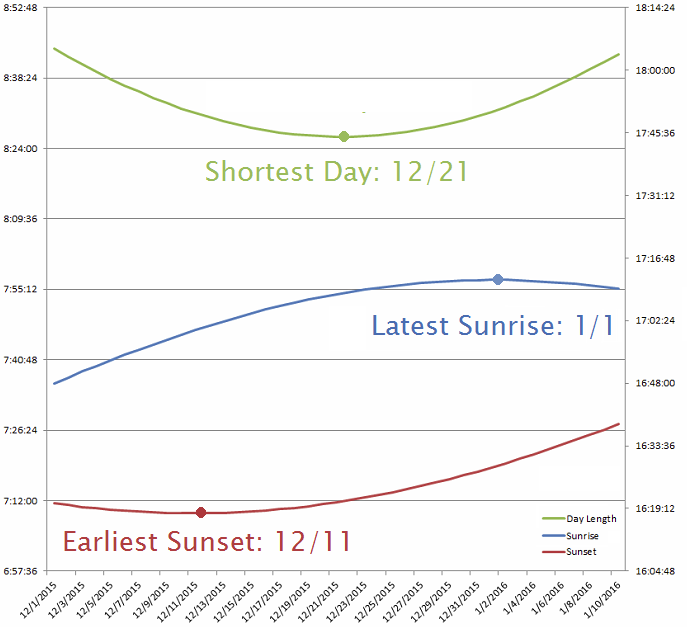 – courtesy Sunrise, sunset and celestial mechanics
Sun’s Position in our Sky traces out the Analemma
If you took a snapshot of the Sun every week at the same time, the path of the Sun would trace a figure-8 curve called the Analemma. The simulation of weekly snapshots shows the position of the Sun at the same time, mid-day, when the Sun is due South and highest in the sky .

See: A Year on Earth
The view can be graphed 2-dimensionally as a Figure-8 curve combining 2 functions.
- The y-axis units measure the declination of the Sun in the sky for one year, going from -23.45° in the winter to +23.45° in the summer. The snapshot shows the Sun position closest to its lowest declination, December solstice (‘winter’ solstice, northern hemisphere).
- Notice that the x-axis measures the difference between observed clock time of the Sun at high noon and the Sun’s position with respect to due South. The Sun will reach the highest point due South either faster or slower than clock time. (There are 4 points where the Sun is ‘right on time’ – no difference in minutes).

There are two reasons why the Sun traces the analemma figure-8 path. These two factors are completely independent but their sum produces this special curve..
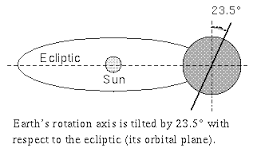
1. The Earth is tilted on its axis 23.5° in relation to the plane of its orbit around the Sun.

2. The Earth does not orbit the Sun in a circle, but in an ellipse. The equation of time measures the difference in minutes by which the true Sun direction (from an elliptical orbit )is faster or slower than the mean (average) Sun direction (from an averaged circular orbit).

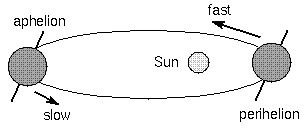 The analemma graphs the sum of the two effects: Earth’s elliptical orbit around the Sun and the tilt of the Earth’s axis in relation to the plane of its orbit around the Sun

.
- East-West movement of the Sun is due to the Equation of time.
- The North-South movement of the sun in the sky: Variation in declination (related to our axial tilt).
The analemma can be graphed showing the Declination of the sun at Noon ( from -23.45 to +23.45 degrees) against the number of minutes deviation between true sun time and mean sun time (clock time).
Tilting the analemma to Sunset Western Horizon and Sunrise Eastern Horizon
The ‘Rising’ Analemma and the ‘Setting’ Analemma at our latitude determines the times of Earliest Sunset and Latest Sunrise. If instead of plotting the analemma at noon, we were to plot the position of the Sun once at week due East near the time of sunrise and due West near the time of sunset, we can see where the Sun touches the horizon at a particular day.
Analemma Sun Rise and Set – courtesy The Analemma for Latudinally-Challenged People
It can be shown that if we tilt the analemma by the amount of our latitude (i.e. 45 degrees) we get a picture of the sunrise and sunset positions. So let’s aim our camera due West at sunset and check the horizon for Earliest Sunset, and similarly, let’s aim our camera due East to find the latest sunrise position. We deduce the dates when the earliest sunset and the latest sunrise occur for a given latitude . The graph below shows us the “analemma-rise” and “analemma-set” graphs tilted for the northern hemisphere, at roughly 41 degrees latitude (Chicago).
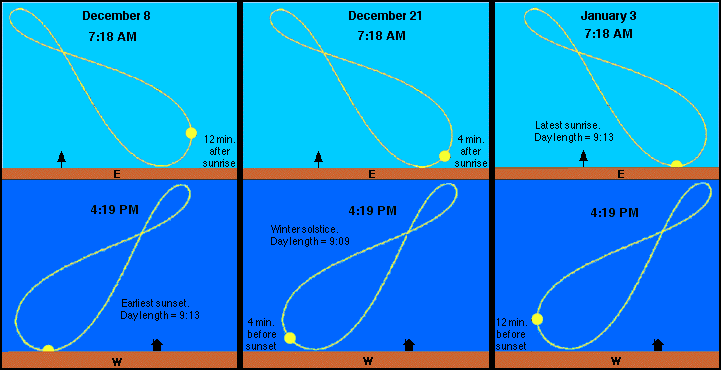
Local observers may notice that Earliest Sunsets happen around now (2nd week in December) and soon thereafter the afternoons ‘turn around’, before winter solstice.


But we’ll have to wait for the Latest Sunrise to ‘turn the mornings ’round’ until after the first week of January.
