


Winter is over. Spring is here. And we are certainly looking forward to opening the cottage for the 2024 season. In addition to soaking in the spring scents and the colours, we are looking forward to seeing the spring migrant birds wend their way north, as well as the early butterflies that are native to Lanark.
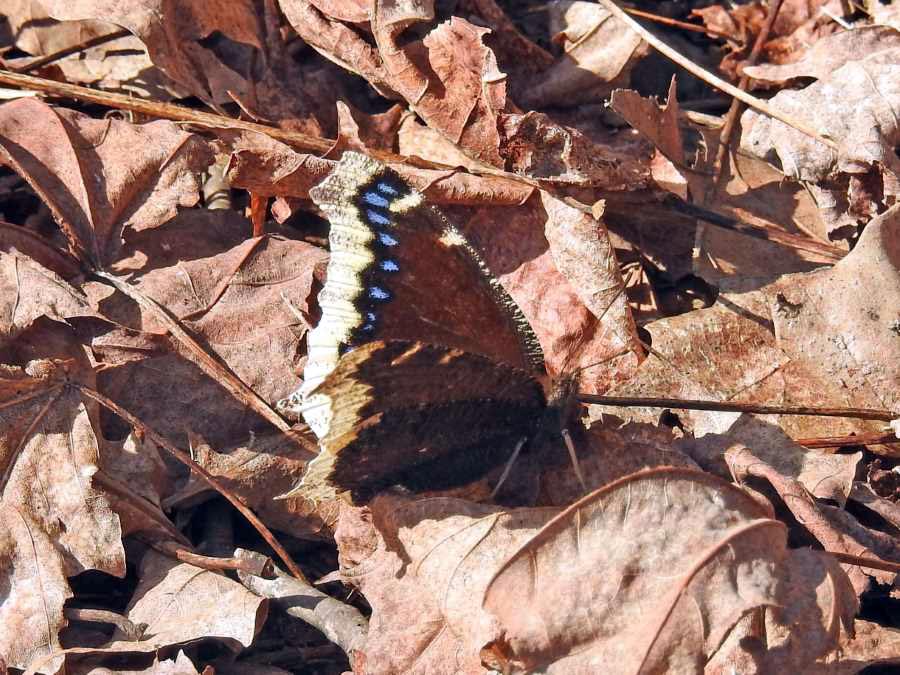
The earliest butterfly we have ever seen is the mourning cloak which, one year, we saw on Apr 10th. At this point it looked at bit bedraggled, having overwintered as an adult, under a bit of tree bark, possibly in leaf litter, or even in a wee space between the planks of the boat house. The mourning cloak butterfly is a brown/deep maroon with a yellow band on the outside edges of the wings, and purple/blue dots along the inside of the yellow band. The larvae develop over the summer, then pupate, with the new generation of adult emerging in time to overwinter.
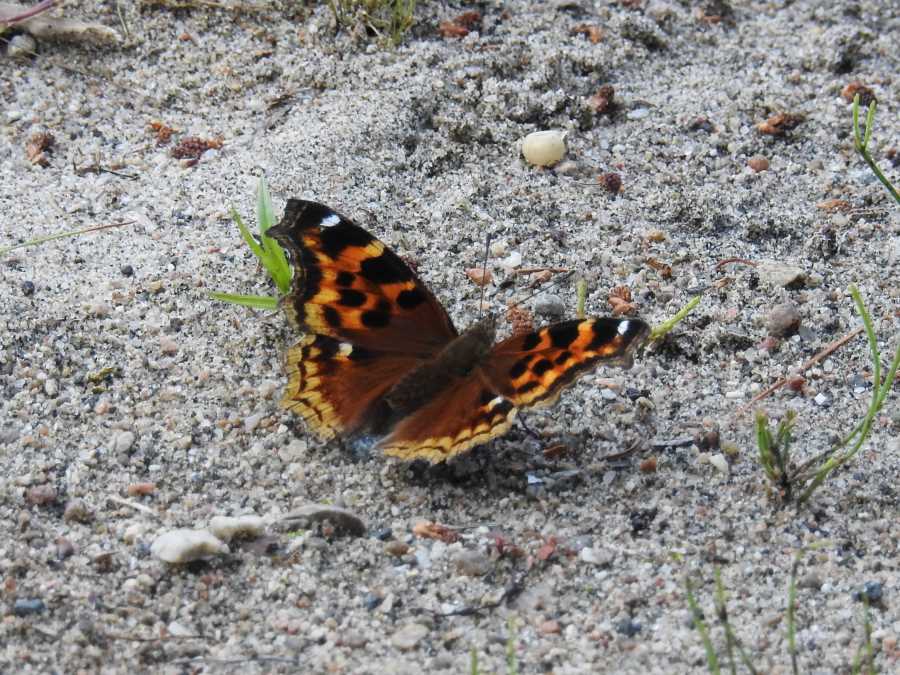
Also overwintering as an adult, the second earliest butterfly we have ever seen at the cottage is the Compton tortoiseshell which we saw one year on April 19th. Overall giving an orangish impression, it is patterned with orange, brown, and black … perfect camouflage while sitting on a tree or leaf litter. Larvae develop from the eggs laid in the spring, then transform to pupa. In turn, the emerging adults fly from July to November before hibernating. And so, the cycle continues for the Compton tortoiseshell, similar to the mourning cloak butterfly.
Early in May, three additional early butterflies have cooperated with our intrepid photographer. First is an azure butterfly. From our reading, we can say that the identification of azure butterflies to species is a great challenge. This butterfly may be a lucia azure. After overwintering as a chrysalis, the adult emerges in time to be called by some people a spring azure. Regardless, we have seen this pretty, small butterfly at the cottage as early as May 9th. They fly about quickly and erratically. When one settles, it is usually to puddle in the damp sand with its wings closed.

Also overwintering as a chrysalis, the Eastern pine elfin is in the same family as the Lucia azure, and behaves similarly too. All of our photographs of the Eastern pine elfin butterfly show it with closed wings, on the ground. One of our favourite early May butterflies, perhaps because its identification seems a little easier than others, we have seen at least one each year since we first learned of them in 2017. This photograph was taken on May 12, 2022.

Last, but not least for this article, is a duskywing skipper which is not considered to be a “true” butterfly because their antennae, wing muscles, and eyes differ from that of true butterflies. Also difficult to identify to species, even for our expert friends, this duskywing is either a Juvenal’s, a Columbine, or a Wild Indigo duskywing, all of which overwinter as caterpillars. We see this species of duskywing most often on the ground at tiny puddles in the lakeside sand or on the roadside, although this one posed nicely on a yellow hawkweed bloom. This photo was taken May 15, 2021.

Clearly, all the butterflies we see in the early spring at the cottage are ones that have overwintered in one form or another, in order to get an early start on the next generation in their life and pollinate early blooming plants. For us it is simply a joy that nature has organized itself to provide us with this cheery, colourful welcome to start our cottage season.
For this article we reread the species accounts in The ROM Field Guide to Butterflies of Ontario by Peter W. Hall et al. This ROM guide is dense with information and we value it greatly.
