

by C. H. Wells
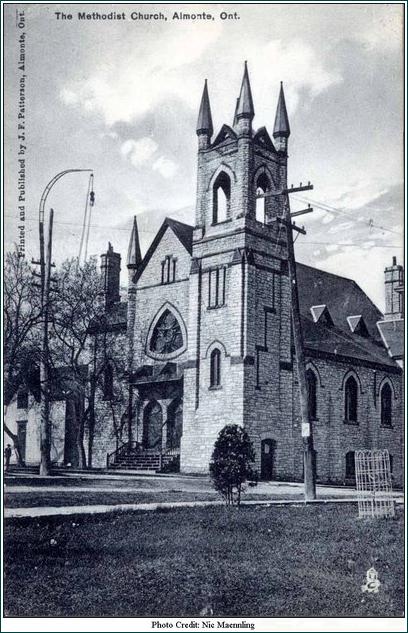 A landmark in Almonte, this stately building, on the corner of Main and Union streets, is about to be changed forever. Its current owner, Chris Loosemore, says he is preparing to demolish the entire Union Street end of the building, including, and most especially, its iconic tower. The cost of restoration, he says, and the complications involved are prohibitive.
With construction beginning in 1886, it was built for the Almonte Methodist Church community (later, Trinity United Church) and dedicated in June of 1887. Its remarkable semi-circular sanctuary drew some eight hundred of the curious to the church’s inauguration ceremony. [A portion of the dome that once stood over it is all that remains, but that alone is still glorious.] The building was abandoned as a church in 1951, when the congregation joined with that of Bethany United Church (forming Almonte United Church) and moved to Elgin Street.
Church records of September 1952, show sale of the building to Wiring Devices Limited of Ottawa (later listed as Almonte Wiring Devices Limited), but two years later the buyer was in arrears on both mortgage payments and taxes [a situation played out several times over the course of the building’s history] and neighbours were complaining about noise from the manufacture of his snow plows, designed for clearing airport runways.
They could not have been any happier with its sale, in 1959, to Walter Motor Trucks of Canada Limited, who manufactured “tractor-trucks, snow fighters and fire apparatus,*” later becoming best known in the area for building fire engines.
In fact, the majority of owners, subsequent to the church, were manufacturers of large, specialized machines: Wiring Devices, Walter Motor, Dungarvon Co. Ltd [whose name still graces the garage bay door header, today] & Bayliss Kenton Engineering among them. Even today’s owner can often be found restoring and testing motorized vehicles himself, in the person of a small fleet of mid-century classic cars [their historical lack of catalytic converters occasioning a visit from the fire department, on one occasion, to rid the tenants’ apartments of toxic levels of carbon monoxide].
If the building’s structure shows visible chinks and cracks today, it is little wonder, and “well-earned.” Decades of oversized vehicles violently shaking the building’s walls and cracking the basement floor have done nothing to enhance the beauty of this grand old dame. As well, from all appearances, no one since its original owners seems to have considered it necessary to maintain the exterior.
Around 1940, while Trinity United still owned the building, a six-inch crack was found in a wall of the upper tower. This was addressed in 1943, with removal of about 30 feet of the tower’s original 90-foot height. An estimated further 20 feet of the tower was lost in 2012, in the wake of the infamous “red brick incident,” when an anonymous ‘concerned citizen’ claimed to have noticed something fall from the tower, bounce off a hydro wire and land in the street. This object was later discovered to be a red brick … which had apparently fallen from a building whose exterior is grey stone.
Despite the lack of any explanation for this curious enigma, barriers were raised and streets were closed off [as many locals will recall], in what, it appears now, was a somewhat overzealous response on the part of Town officials. The cost of said overreaction was later ‘downloaded’ onto the owner’s tax bill, to the tune of some $30,000. He was then ordered to lower the tower.
Today, once again, barriers and fencing blight the corner of Main & Union, surrounding the notorious poised-eternally-on-the-brink-of-imminent-collapse tower. [Rather like Schrödinger’s cat.] The Town has demanded these “safeguards” of the owner, because of … [wait for it] … an anonymous complaint from a ‘concerned citizen.’ [Hmm … Makes one wonder, doesn’t it?] Frankly, I preferred last year’s garden, which was just as effective in keeping people off the grounds.
There is no doubt Chris Loosemore could have, and probably should have, handled things differently … chosen different priorities … during the course of his 20 challenging years of ownership. And certainly the Town has had many decades during which it could have dealt with the state of this building differently. [Though, to be fair, a succession of different owners and many changing Town officials over those decades would not have made this easy. However, the reader might also take note that during the Town’s own brief tenure as owners, officials did nothing to improve the state of the building or its offending tower.]
The question remaining, perhaps, is: What now? Is there no fate for this historic edifice which has stood at the threshold of “Piety Hill” for some 137 years, but mutilation and ignominy? Is it doomed to be obliterated from Almonte’s history? And more importantly, should it be?
Who knows how many of Almonte’s citizens were married, baptized or buried from this building in its six-and-a-half decades of service as an active church. Or how many human lives it has hosted in its long life: congregants, machine shop workers, administrative staff, a cadre of residential tenants now calling it home, and a succession of owners. For the latter it represented their hopes for the future, and sometimes heartache and hardship, too.
It has lasted through violent storms, earthquakes, vandals, and 70 years, off and on, of thundering combustion engines rumbling in its belly. It seems to me ignoble to deface this venerable structure – to destroy, in fact, its most prominent feature – because of previous negligence. Because it doesn’t look quite so pretty anymore. Because it hasn’t been properly cared for, or cared about. [When the current owner first arrived, he found the concrete basement floor buried in dirt and a tree growing through the window!]
Ad hominem arguments aside, what will it be replaced with? Cinder block with vinyl siding? Faux stone? Even the most tasteful addition by today’s standards is likely to look dated in a mere decade or two. Real stone, on the other hand, never looks ‘dated’: it only looks enduring. Why mess with a good thing?
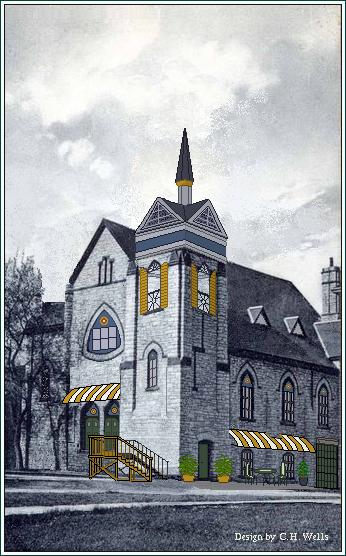 I am convinced that even the most jaded critic would find a new appreciation for this old gal were she stabilized a little, given a lick of paint, some serious re-pointing and a mini-makeover. [One of my own design ideas is shown here, by way of illustration.] There are undoubtedly scores of ideas that would honour the church’s original architecture and marry the old with the new, without requiring a complete restoration, or a tear-down.
Can no compromise be found? If the present owner is prevented by circumstances and/or finances, from choosing the most heritage-sensitive solution, then whose responsibility is it to see that this choice is made? That Almonte does not lose another gem from her delightful box of bijoux?
Let this serve as a shout-out to any other heritage buffs out there, to all who hold a similar affection for the relics of our past and feel a like sense of responsibility for protecting and preserving them. Together, can we not find a way to “Save the Tower” for posterity and ensure this elegant old building lives on for even more decades, contributing to Almonte’s architectural treasure trove. We need only polish her facets, stabilize her setting, and buff out a chip or two, and she can be a shining jewel, once again, in Almonte’s crown.
————————————-
* Quote taken from: The Wind Bloweth Where It Listeth: A History of Almonte United Church and Its Roots 1821 – 1981. Written by Winston A. MacIntosh. Pubs., Almonte United Church.
All information on dates, names and facts about the building’s history as a church has been taken from this book, which is available at the Almonte public library.
