

Reflections from the Swamp

Dear Reader,
I’ve spent most of my life spreading manure—both in the garden and, if I’m honest, in my writing. In both cases, the trick is balance. A little manure enriches things; too much, and you’ll smother what might have grown into something beautiful.
Gardeners, as you know, use all kinds of fertilizers. The packaged kind comes with clear tables indicating the amount to use per square meter. Manure, however, is more unpredictable. It’s primarily suitable for adding nitrogen and humus, but it’s not a balanced fertilizer. In life, as in soil, balance is everything.
We acclimatize to both the good and bad smells around us. The aroma of a bakery is unforgettable. Step into Baker Bob’s, and the heavenly fragrance of fresh bread greets you. Stay there long enough, and you stop noticing it. Likewise, if you drive around with a van full of manure, you’ll stop smelling it too—though your passengers won’t. Those pine-scented air fresheners dangling from the mirror are no match for nature’s truth.
In good fictional writing, readers look for authenticity — characters and emotions that feel true even in imagined worlds. They seek balance between clarity and mystery, where each word enriches rather than clutters the story. Above all, they crave transformation — a sense that something, whether in the characters or themselves, has changed by the end.
Unfortunately, our minds acclimate to the daily bombardment of a different kind of manure—from newsfeeds, social media, and endless chatter. It’s spread thick, steaming, and unfiltered. At first, it’s shocking. However, after a while, we become accustomed to the smell. We close the windows, light some scented candles, and pretend it’s normal. Then winter comes, and we hope the snow will cover it all up. But, as it always does, the snow melts—and the truth seeps back to the surface.
The Fertilizer of Words
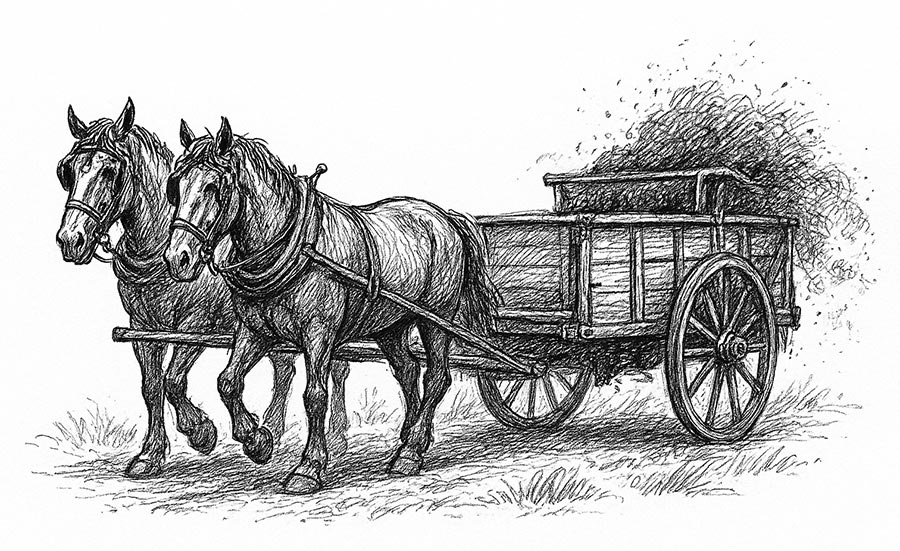
Delmer, my neighbour, an armchair philosopher, understood manure better than most. You can often see him wearing his Montreal Canadiens ball cap, a red and black checkered jacket, and rubber boots, out in his garden. He has been gardening for most of his seventy years and continually improves his soil and crops. Every spring, while others opened neat bags of commercial fertilizer, he would roll out wheelbarrows piled high with horse manure—rich, glistening, and aromatic enough to make even the worms gasp for fresh air.
“This,” he’d declare proudly, “is the scent of life itself!” I knew he didn’t mean life stinks, so I let his statement stand.
Delmer’s garden thrived under his earthy devotion. His tomatoes glowed like small suns, beans climbed ambitiously toward heaven, and his carrots grew stout and smug beneath the soil. But one spring, Delmer grew overconfident.
“If a little manure brings life,” he mused, “then a lot will bring a super crop!”
So, he spread it thick. Too thick. For a brief moment, his garden looked magnificent. Then came the slow rebellion—tomatoes browning at the edges, beans had bright green leaves with no flowers, and cabbage plants that were huge but didn’t form heads. Delmer scratched his head. “Perhaps manure has a limit,” he sighed.
That evening, he turned to his writing—a weekly essay about truth and beauty. But when he reread his draft, he noticed something familiar: his ideas were buried under too much cleverness, too many metaphors, too much manure.
“Ah,” he said, “too much manure here as well.”
So, he trimmed the excess, pruned his adjectives, and let the truth breathe again. His essay recovered its balance—rooted in honesty, enriched by just enough embellishment to keep it alive, but not so much as to choke the life out of it.
He leaned back, smiling. “Manure,” he mused, “is like humility—it works best when it’s under the surface, not spread all over the place.”
In tending both garden and prose, Delmer found the same truth: growth comes from balance, patience, and a touch of humour. Too much fertilizer—of any kind—only burns the nourishing roots. It all seemed as obvious as the nose on a moose.
So let us all be careful manure spreaders. Let us season our soil and our sentences with wisdom, not excess. For in both gardens and in writing, it’s not the quantity of manure that matters—it’s the quality of what grows from it. The art of life is knowing when to let things flourish naturally and when to take a shovel and add a little manure.
