

Part 3 in a series about Light Pollution, by Rick Scholes
In 2023 two astronomers invented a new word: “Noctalgia.” It means sky grief; grief over the loss of the night sky to light pollution. It turns out that artificial light also causes measurable losses when it comes to human health.
Research into the effects of artificial light on our health, and that of other species, has been a growing area of study for years, since so much of our population is exposed to it. A comprehensive repository for these studies can be found on the United States National Institute of Health (NIH) website. Many of the studies on humans looked at shift workers who are exposed to more light at night in the course of their work. Links to obesity, diabetes, other metabolic and cardiovascular disorders, mental health, immune function, reproductive processes, ophthalmology, and cancer have all been found. It may seem unlikely for cancer to be caused by light pollution. However, the point is that disrupting circadian rhythms leads to hormonal changes that can affect other metabolic and cardiovascular systems in our bodies.
LED lights in our homes and on our roads have significant blue light content, even the supposedly warm colour temperature lights rated at 3000K (as explained in Part 2 in this series). Artificial light, and blue light in particular, affects the quality of human sleep by interfering with the release of the hormone melatonin. Blue light is emitted from basically all our display screens: computers, tablets, televisions, smart phones, and consoles. For this reason, health practitioners recommend avoiding them before bedtime for good sleep hygiene (like the concept, dislike the phrase). There are many potential causes of sleep disorders but artificial light is an easy one to reduce or moderate.
The overabundance of light disrupts the balance in nature, the ecology on which we ultimately depend. All the other forms of life on our planet have to figure out how to survive in this overly lit up world we foist upon them. The birds, the bees, the fireflies, the trees, virtually every living thing.
ALAN
Organizations concerned with health sciences and ecology often use the acronym ALAN, which stands for Artificial Light at Night. For my purposes, ALAN and light pollution are the same thing. ALAN is a more neutral term that refers to any artificial light at night, whether it pollutes or not, but the reality is that most of it does pollute. (The acronym may be easy to remember but it makes internet searches a challenge because you find a lot of papers authored by Dr. Alan Somebody!)
As ALAN spreads into our suburban and rural areas, it begins to effect more and more living creatures besides humans. In the animal world, it can turn the predator-prey relationship upside down. Predators with good night vision are put at a disadvantage. Those that require light to hunt can hunt all the time. The effects are difficult to predict since there are various other factors like camouflage and sleep patterns.
For the Birds
The effect of ALAN on birds has been well documented. Owls, for example, are a night predator that rely on darkness to hunt. Artificial light changes bird feeding and breeding patterns, and thus habitats may be altered. Some birds avoid artificial light, while others are attracted to it. An extreme case is the 9/11 tribute lights in New York City, shown below, with its two soaring searchlight beams directed upward. Nature Conservancy Canada reports that up to a thousand birds can become trapped in these light beams and die of exhaustion. Thanks to lobbying by birder organizations the lights are now periodically switched off to allow the birds to disperse. It’s better than nothing, but the birds are still affected.
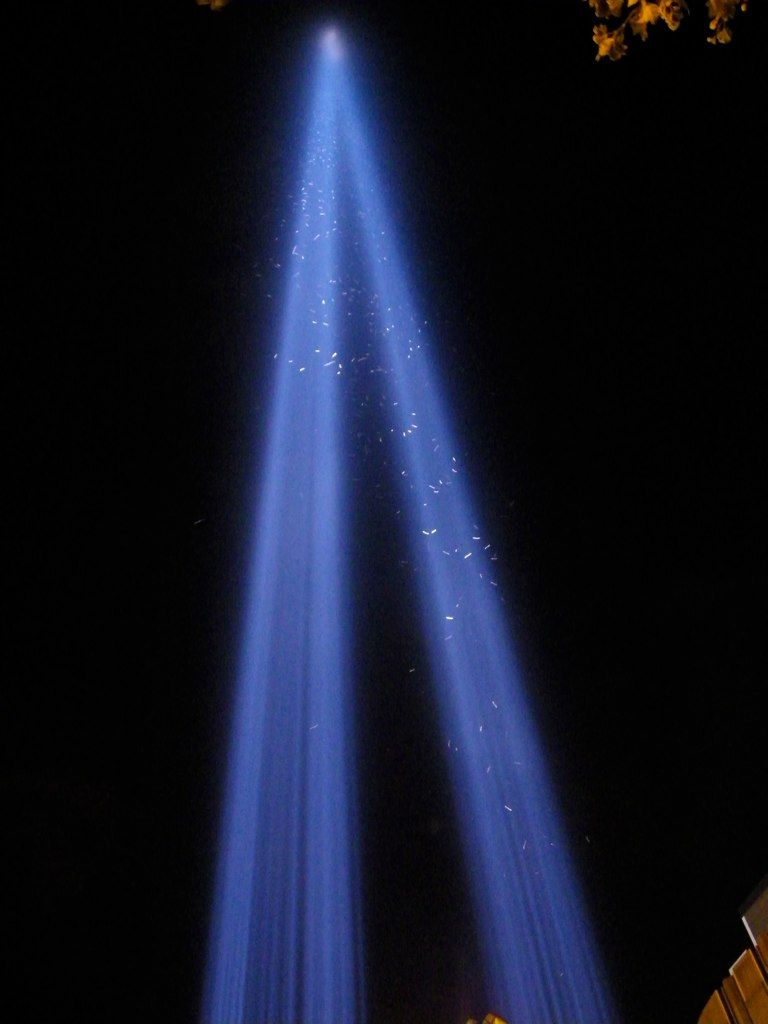
Image credit: B. Tofte-Schumacher (Wikipedia Commons)
Birders may be familiar with an organization called the Fatal Light Awareness Program, or FLAP. This charitable group is an authority on bird-building collisions. They promote office building lights being switched off at night because, quite simply, lights kill birds. FLAP monitors provincial building standards in order to speak for a species that does not have a voice in government.
Light from residential windows can also lure birds. An organization based at Indiana’s Purdue University tracks bird migration on their website. They issue state-by-state alerts based on real-time migration data and promote non-essential “lights out” from 11pm to 6am at critical times. From the perspective of light pollution, it would be best to simply make this a habit at all times. What can you do? Dimming or switching off outside lights and closing curtains will help the birds and reduce light pollution at the same time.
A Bug’s Life
As you swat mosquitoes buzzing around your ears it’s tempting to wish for a world where such pests do not exist. Yet all insects are important to our ecosystems, and many species are in decline for anthropogenic (human-caused) reasons. One of those reasons is light pollution. Consider the firefly – and who doesn’t love a firefly? Their bioluminescence is what attracts a mate. Brighter nights due to skyglow reduce the contrast and therefore their ability to recognise these signals. You won’t see any fireflies in overly lit areas, not because you can’t see them but because they’ve been displaced.
According to a review paper published by the National Institute of Health, artificial light affects insects in the following ways: disorientation in space and time, attraction, desensitization, and recognition. Many insects navigate based on natural light cues (the sun and the moon) so a bright artificial light forces them into a tight death-spiral. Skyglow, on the other hand, simply desensitizes them. Mosquitoes and moths are both particularly attracted to ultraviolet and blue light. Studies of bees have found that ALAN affects their dances, circadian rhythms, and even the pollination processes (particularly nocturnal pollinators).
The recent adoption of LED lights presents an even graver risk for the insect population due to the blue light content. Research has found that they attract insects about twice as much as the previous streetlight technology, High Pressure Sodium (HPS). A comprehensive NIH review paper concludes that for insects the adoption of LED lighting “represents an ecological experiment on a global scale, with potentially devastating results.”
Planting a Seed
Growth and harvest cycles of agriculture are altered by artificial light at night. It affects the photosynthesis process. This makes sense when we remember that, like humans, all the flora evolved over millennia during which time there was no artificial light. Some roadway lighting manufacturers have recognized this and offer products with tailored beam angles that illuminate only the road and not nearby fields.
There is a pleasing effect when a spotlight is placed under a tree and pointed upward. As well as adding skyglow, this unnatural light affects the trees growth cycle. The image below shows a streetlight that has delayed the leaf fall from lower tree branches, making the tree less prepared for dormancy and more susceptible to frost damage.
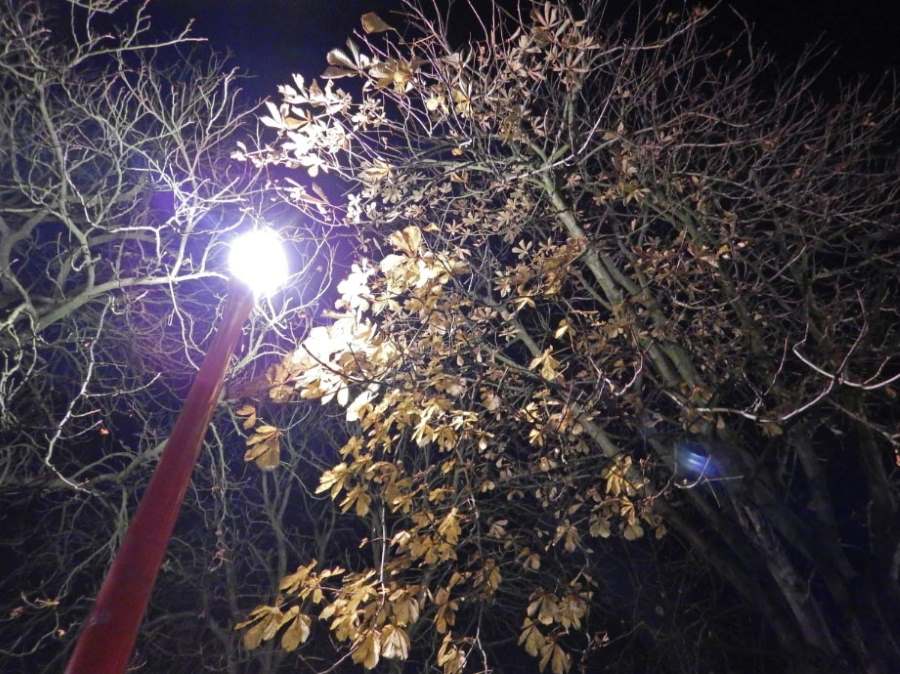
Image credit: Lamiot (In Defense of Plants, CC BY-SA 4.0)
Lighting trees and vegetation impacts the natural habitats of any creatures living nearby or seeking shelter from predators. You can reduce the negative effects of such property lighting by using them only on special occasions or using timers to switch them off when there’s no audience.
Greenhouses that use grow lights (often LEDs) at night to extend (indoor) crop seasons can end up in conflict with neighbours who don’t want light trespassing onto their property all night. Communities thus affected have recognized that regulations are required to limit such (external) light pollution.
Turtles, the Climate, and Everything
You might think that aquatic creatures are immune to the effects of artificial light. Not so! The best example is the sea turtle. Sea turtle hatchlings are disoriented by artificial lights near shorelines because they also use natural light cues to return to the ocean after they emerge. Shorter wavelengths (bluer light) are worse, meaning again that LED lighting has exacerbated the problem. A number of coastal regions have introduced bylaws to restrict the intensity, colour, and light fixture design to mitigate this problem. Less disruptive amber or red lights are often referred to as “turtle lights” in this context.
Reducing light pollution can even help the Earth as a planet, and by extension, us. Any waste of energy adds carbon dioxide (CO2) emissions to our atmosphere, which are known to cause climate change. Operating lights more than is necessary, or using a higher intensity than necessary, wastes power. Buying unnecessary lights wastes the resources that went into their manufacture and distribution. Climate change is a daunting problem, but reducing ALAN is much easier. Humans and the rest of our planetary companions will be healthier if we tame our obsession with artificial light, an obsession unique to our species. Here’s hoping that noctalgia will nudge us toward healthier uses of artificial light.
Part 4 in this series, “The Night Sky: Glaringly Obvious”, will discuss how safety and crime relate to lighting, and why dimmer, warmer, or more thoughtful lighting is the better choice.
