

Part 1 in a series about Light Pollution, by Rick Scholes
At some point in your life, unless you’re an urban dweller who’s never left the inner city, you will have beheld a crystal-clear night sky full of bright stars, the splash of the Milky Way arcing overhead. Do you remember it? Perhaps you were at a cottage, or camping, or in a dark sky preserve such as Manitoulin Island or Mont Megantic. Was it not breathtaking? Under a truly dark night sky, the Milky Way can even cast a shadow!
Humans, and indeed all life on Earth, benefit from nighttime. An alien observer might not guess this, based on how much we illuminate it. The millennia over which we evolved were lit only by the pale moon on its monthly circuit around the Earth. We need darkness to activate the hormones that prepare us for sleep and allow the body to rest and rejuvenate itself. Morning light activates different hormones to wake us up, the night/day cycle regulating our circadian rhythms. All plants and animals, flying and sea creatures, have adapted to cope with darkness in different ways. Human eyes have separate receptors for daylight (cones) and low light conditions (rods). Too much light at night renders our rods ineffective.
Artificial light, not counting fire, has been available for only the blink of an eye in evolutionary terms. It was just a hundred years ago that incandescent electric lights became the dominant light source across the developed world. The spread was rapid. Today, it is estimated that 30% of all humans and 80% of North Americans are unable to see the Milky Way from where they live. Artificial light has rendered much of our very own galaxy invisible to us. Ninety-nine percent of us live under light polluted skies.
The degradation of our night skies at the Fred Lossing Observatory outside of Almonte is demonstrated in the photos shown below. The photo on the left was acquired with image processing techniques to show how the Milky Way should look, and would have looked five decades ago. The photo on the right approximates how it appears to the naked eye now, in 2025.
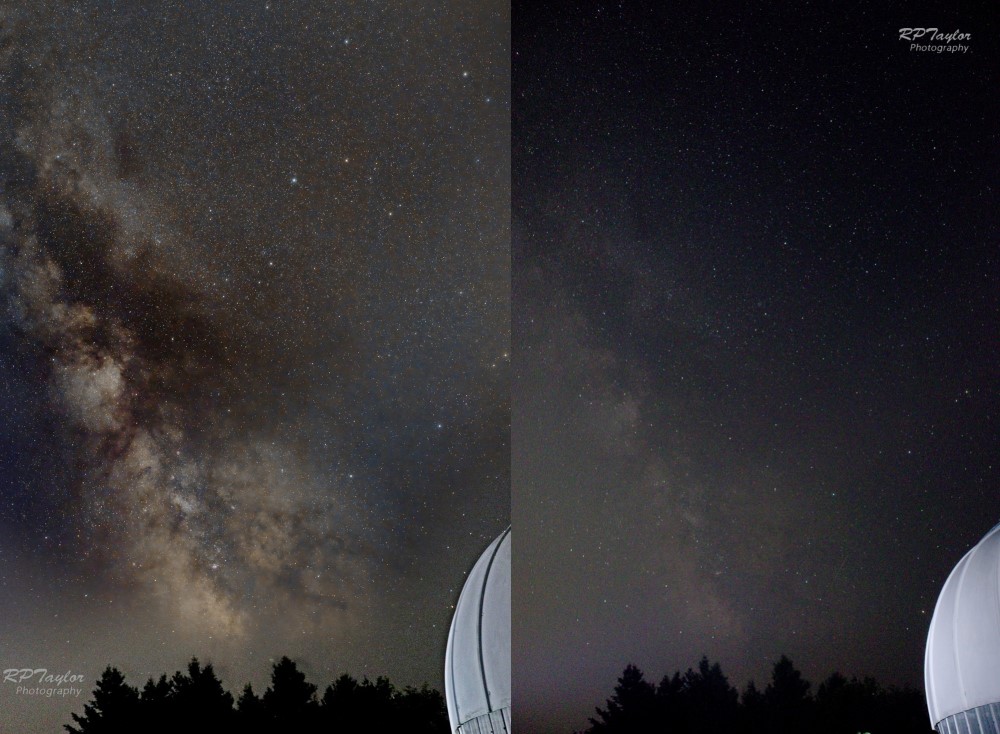
Photos: R. P. Taylor, RASC Ottawa Centre (CC-BY-NC)
The night sky is a natural resource. It’s part of our natural environment. Culturally, it has been a source of beauty, inspiration, and storytelling throughout history. Countless songs and poems have been written about the moon and the stars. Countless tales of gods and creatures have been invented by all cultures as they looked up and imagined patterns in the sky to illustrate their stories. The stars had practical uses too, for navigation, determining latitude, and measuring time.
Like all natural resources in today’s world – air, water, trees, wildlife – the night sky is under threat. In urban, suburban, and even urban-rural transition regions like Mississippi Mills, we are awash in artificial light. Much of it is unnecessary. As a result, thousands of individual stars and the billions that together form the Milky Way are washed out. It’s another way we’ve become disconnected from nature.
Most of us shuttle from brightly lit homes along brightly lit roads to brightly lit workplaces, where we stare at bright screens. It is easy to forget the stars unless you happen to be an astronomer, studying the night sky out of personal or professional interest. Astronomers were among the first to sound the alarm about what we call “light pollution”. In a sense, astronomers were like canaries in the coal mine, warning of an impending threat. This threat now affects nearly everyone because humans and our natural resources are connected, ultimately dependent on each other.
Light Pollution (LP) can be defined as either light directed upward into the sky, or excessive or unnecessary light that impairs vision. A portion of any bright light will reflect (from grass, sidewalks, cars, pavement, buildings, etc.) and light up things it should not. Since a certain amount of light is necessary, we need to strive for better, more thoughtful lighting. This means choosing the brightness, colour, and light coverage adequate for the job and no more.
LP wastes energy, messes with our sleep, and poses a potential safety hazard. The energy that light carries off into the sky or our neighbour’s homes is squandered, as are the dollars spent to create it and consume it. Light is now cheap, and cheap things tend to get wasted. In case you think there are no major consequences to the average person, consider that Dark Sky International has estimated that 21 million tons of CO2 was added to our atmosphere because of unnecessary lighting in 2024. In other words, it contributes to climate change.
The term light pollution came into use about 50 years ago. Awareness and concern about pollution of all kinds – air, water, land, noise – entered the mainstream in the 1960s and 1970s. This led to various remedies, such as catalytic convertors for vehicles, waste water management regulations, littering fines, and noise limiting bylaws. It’s ironic that light is a less visible problem. And compared to other environmental challenges we face, it’s as easy to combat as … switching off a light.
Satellites have mapped and monitored worldwide LP since 2006. This data is available online so you can zoom in on your area and year of interest. A recent world map is reproduced below. False colours indicate the amount of light reaching the satellite. Oceans, unlit and unpopulated, are dark so the outlines of the continents can be seen clearly. The most light-polluted areas are white, red, and orange: Eastern North America, Western Europe, the Middle East, India, and the Far East coastlines. Moderately lit areas are green and blue. The least polluted areas are grey and black.

Image credit: David Lorentz (https://djlorenz.github.io/astronomy/lp/)
Light going upward doesn’t just disappear into space. It causes skyglow. Skyglow is light that reflects back to us from air and water molecules and aerosols (dust, chemicals, other pollutants). The skyglow over population and industrial centres is often called a light dome. The light dome of a large city can be visible from a hundred kilometers away or more, depending on conditions. Ottawa’s light dome is easily seen from Lanark County. Almonte has its own (smaller) light dome. Skyglow is responsible for degrading the night sky at the Fred Lossing Observatory, and in your unlit backyard.
Numerous studies done over the years conclude that artificial light has measurable negative effects on our health. Medical professionals have linked it to the risk of headaches, fatigue, stress, and also more serious conditions including diabetes, obesity, mental health, and even cancer. Some of these risks may be very low, of course, and there are lots of variables when it comes to human health. However, it’s hard to argue that sleep isn’t important to our well being, and good sleep benefits from proper darkness.
The astronomy community has developed LP mitigation strategies over the years. Telescopes can be augmented with “pollution filters” that block some of the skyglow from getting to the eyepiece. Sophisticated imaging systems and software can be used to improve the contrast of astro-images, as demonstrated by the Milky Way photo shown earlier. The professionals, of course, simply build their observatories in remote locations such as the mountains of Chile, or book time on the Hubble Space Telescope. Astronomer’s work-arounds do nothing to help us behold a beautiful starry sky or get to sleep when there’s not enough darkness.
The point is that light pollution has gone well beyond being an astronomer’s problem. It’s become a problem for all biological systems including humans. There are many negative health impacts and safety risks. Some are well known, such as the disruption of our circadian rhythms. Others are less publicised, such as the effects on the flora and fauna in the environment. Trees and gardens, birds and insects, nocturnal predators and even sea turtles are affected. Risks to humans due to annoying glare and light trespass from unshielded lights tend to be overlooked because of fallacies about what constitutes safety. Glare is light that temporarily blinds you, an obvious safety problem. Light trespass is exactly what it sounds like: light that trespasses onto someone else’s property.
What can be done? That’s where light pollution abatement (LPA) comes in. LPA is a growth business. More and more people are recognizing the benefits to us and the ecology in general. Consequently, manufacturers are offering new products that pollute less. Lighting engineers educated about these concerns are taking them into account in their designs. Communities are addressing excessive lighting in their property standards and bylaws. Individuals have plenty of options when it comes to making better lighting choices. But there are still many people and organizations that haven’t considered the problem or the solutions, hence the need for increased awareness.
Over the past ten years a game-changing new lighting technology has been widely adopted: LED lights. As with any new technology, there have been unforeseen consequences and ill-considered deployment. This has caused setbacks to our progress on light pollution abatement, as explained in Part 2 of this series. Other upcoming articles will discuss the effects of artificial light on the ecology and health (Part 3), misconceptions about the links with safety and crime (Part 4), and the various light pollution abatement initiatives that we can pursue (Part 5).
In the meantime, think about the last time you saw that perfectly dark night sky and an awe-inspiring view of the Milky Way. Think about how that made you feel, and how wonderful it would be to regain some of that fading beauty.
Part 2 in this series, “The Night Sky: LED Revolution”, will discuss the advantages and threats presented by this new technology that now dominates many lighting markets.
