


Some biologists define songbirds as those perching birds known for their almost musical songs. While all birds vocalize to communicate, court, or defend territory, some bird songs are not as melodious as others, some such as the great blue heron are not melodious at all. Yet, we persist in calling the vocalizations of all of the birds at the cottage ‘song’.
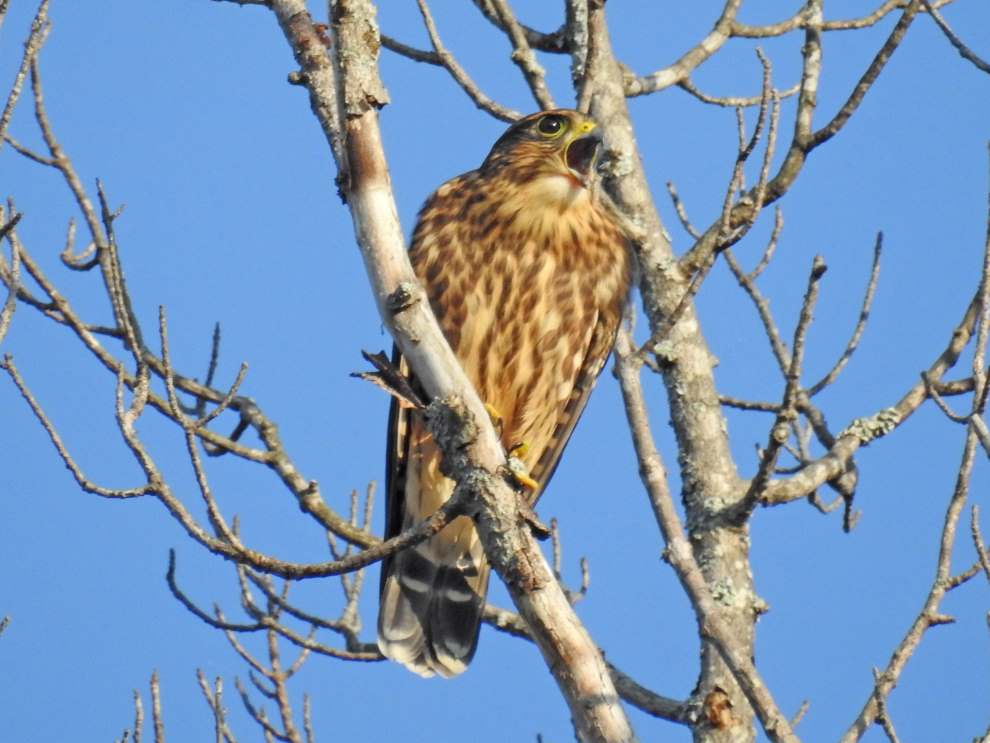
Take for example the merlin, which is the only falcon we see at the cottage. Small at 25 centimetres in length, both male and female merlins give a shrill, chattering call, not quite singing. The calls are used in courtship as well as aggressive situations. The merlin’s shrill and chattering calls can last as long as four seconds. One year near a cottage neighbour’s, a merlin found a perch partway up a tree from which it often scanned the open area for prey. Our neighbour certainly was not lulled by the daily repetitious, continuous, and loud ki-ki-ki-ki calls, especially not at sunrise. If she had been a violent woman, there is no saying what she might have done.
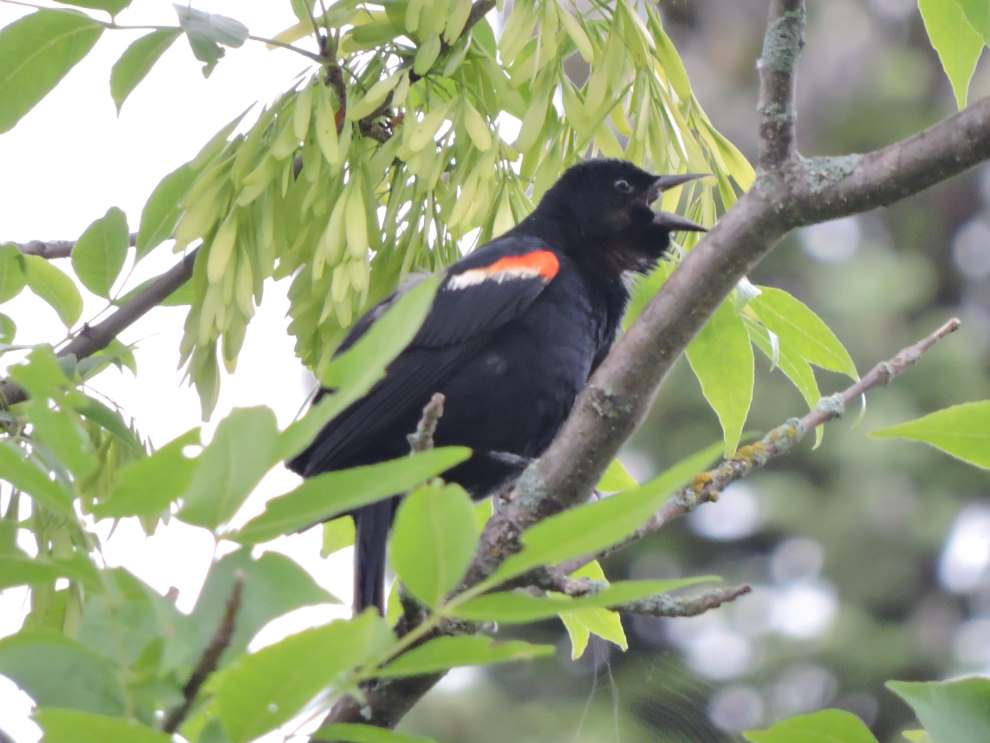
We would describe the red-winged blackbird’s song as a trill, although our field guides offer a number of complicated descriptions including, for the male, kronk-a-rhee with a nasal metallic undulating ending. Sometimes we wonder if it is worth the effort trying to describe any bird call with words. For the most part we see and hear red-winged blackbirds at the edge of the nearby marsh as early as mid-May. We have not seen red-winged blackbirds after the first of August which is when their migration south to open wetland areas begins.
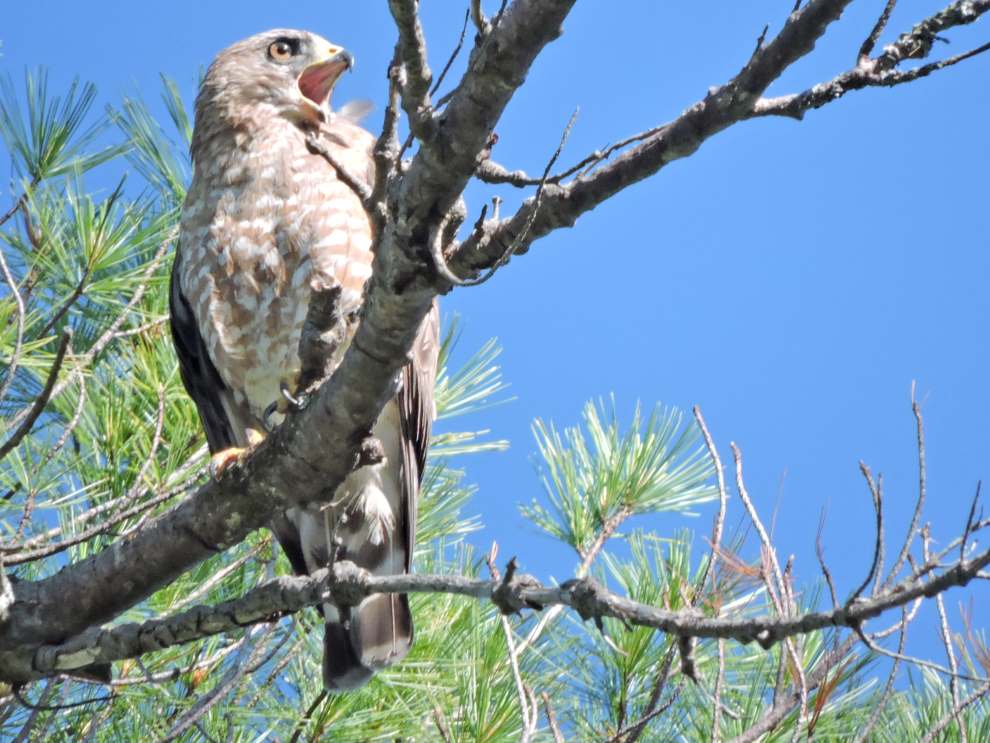
The broad-winged hawk is one of our smaller cottage hawks, measuring 38 centimetres in length. The broad-winged hawk’s call is a piercing, high-pitched whistle, characterized by Canadian ornithologist Dr. David Bird as pee-eee-ah. We have seen the broad-winged hawk each year since we first identified one in 2015, by specifically looking for them high up in the forest canopy when we hear their call.
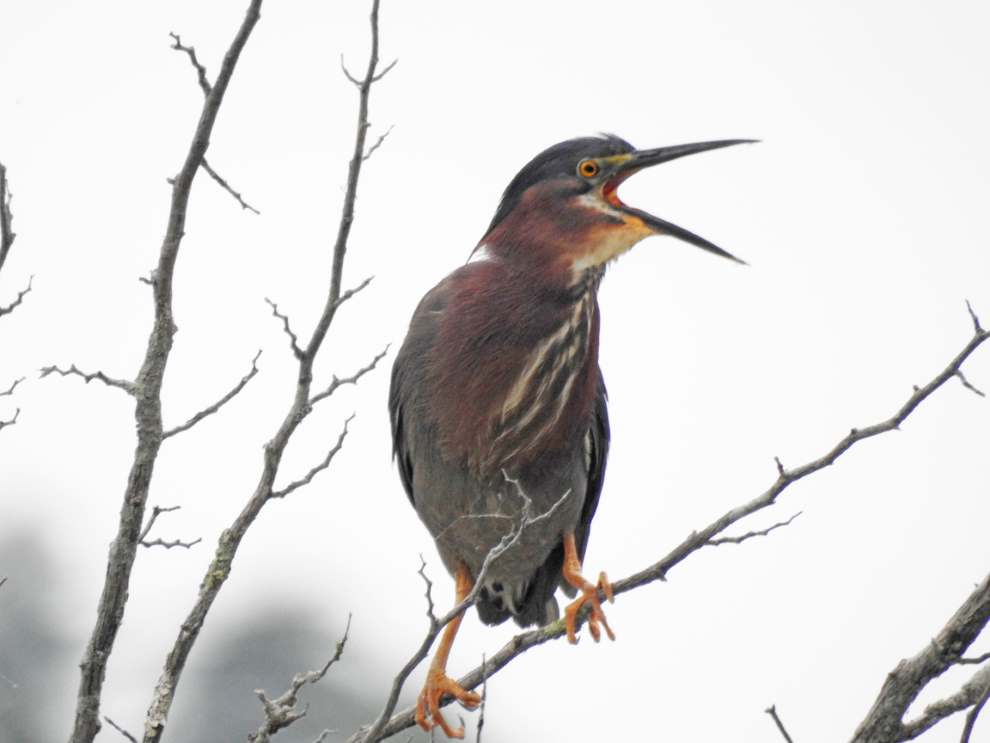
Certainly not known as a songbird even though it is an integral member of our marsh chorus, the green heron’s squawking keow when flying draws our eyes and ears towards the sound. We consider the day special when we hear and see a green heron. They are solitary marsh birds in the same family as the great blue heron which we see almost daily and the least bittern which we rarely see. Like their cousins, green herons feed primarily on fish, but also frogs, large insects, and spiders. Three Mile Bay which lies close to the northern edge of the Lanark Highlands is near the northern edge of this heron’s range which may explain why the green heron is a rare treat to see. Its colouring is an effective camouflage.
Most years we see osprey, our attention being drawn by either its flight along our shore or its high, shrill whistles as it sits high up in one of the tall white pines close by. Dr David Bird describes the osprey’s voice as slow, whistled notes yiooop, tiooop, tiooop. We are often able to watch an osprey perched conspicuously on the neighbour’s white pine when it suddenly flies out and dives to catch a fish with its talons. Sometimes it is even successful in capturing dinner.
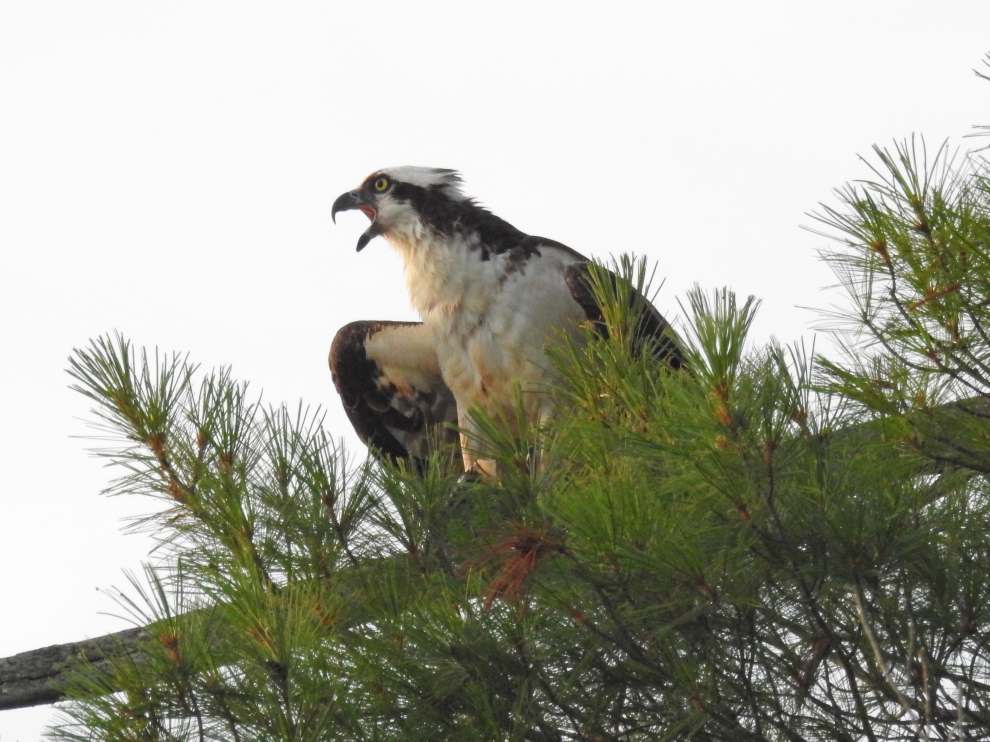
All birds make sounds whether hisses, grunts, whistles, or tweets, and the ‘song’ of the larger birds may be closer to being a squawk. Nevertheless, we love them all even the loud, sometimes annoying merlin. We can hardly wait to get back to the cottage to revel in their varied, usually distinctive ‘songs’.
We like to go to Allaboutbirds to listen to their audio clips of the sounds made by individual birds. In addition, for this article we looked at David Bird’s Birds of Eastern Canada, and Chris Earley’s Hawks & Owls of Eastern North America.
