

by Allan Goddard
Hello readers!
I have had numerous inquiries from concerned residents in Almonte about the fall look of many trees in town. In fact, all the trees appearing like this are the exact same! They are hybrid maple trees—a genetic cross of our native red maple and silver maple. This hybridization is attempted to potentially enhance the good qualities of both species.
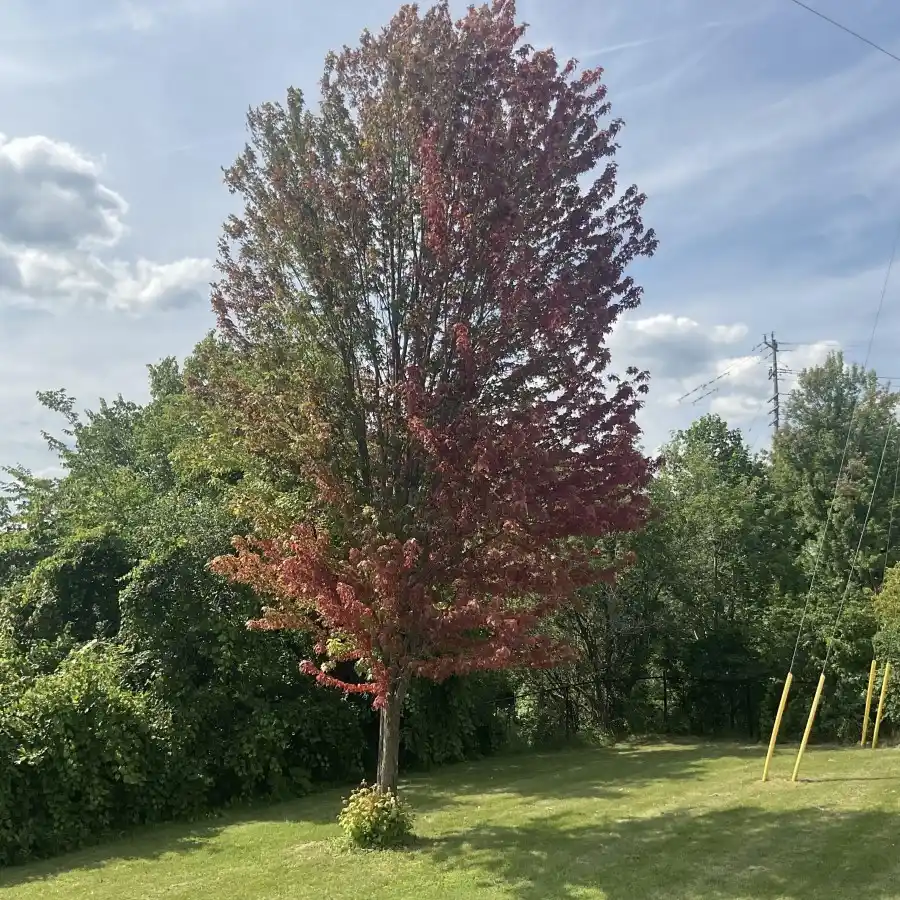
Well, in this resulting maple, the colour sure came through—albeit a tad too early, in the middle of July. (Imagine you are reading and seeing this in mid-July.) The form is good, it shows rapid growth, and it has appeared to thrive in many of the landscapes in town. Or has it…?
The native parents, red and silver maple, are most often located in their natural habitats of moist, swampy, and marsh-like conditions. Are all of these trees we see in and around town in such conditions? Of course not.
Perhaps the breeders found the hybrid to be a candidate for landscape and park trees. Well, it has been—for a few years, anyway. So why the reddening leaves now? Let’s find out:
Here we see the first reason: the apparent splitting and opening of the trunk’s bark. So why is this causing the reddening of the foliage?
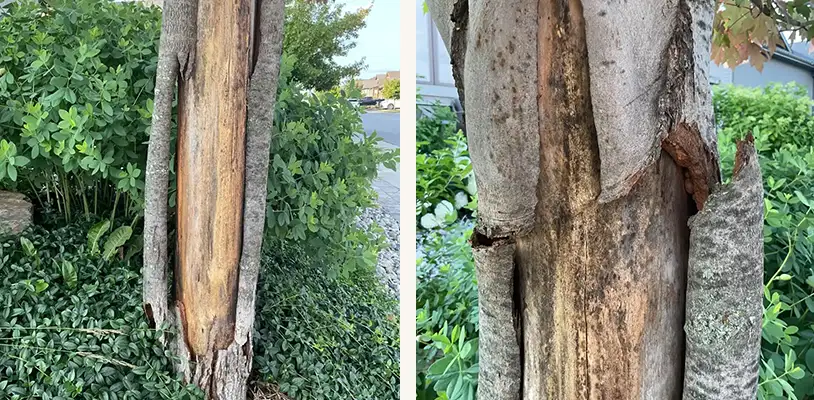
Between the bark and the wood is a single-celled layer called the vascular cambium. This is the critical growth tissue in the tree. It has the magic ability to create cells on the inside toward the wood to make new wood, and to create bark cells on the outside to create new bark. Think of it almost like holding a thin piece of paper only one cell thick around a cardboard tube: the outside of the paper is bark, and the inside is wood.
If this layer of cells—which we often feel as slippery on cut wood when the bark comes off—is damaged or lost, the growth patterns on the tree are interrupted. All of them. These photos indicate very damaged bark. The question, of course, is why, which I will mention soon. The damage has cut off the water and nutrient supply to the foliage above, thereby reducing the growth of chlorophyll, the main green pigment responsible for the overall growth of the trees. Normally, we see the colors of the trees change in the fall when tree growth ceases, chlorophyll is no longer produced, and the color pigments show on their own. But this change is abnormal. Notice, too, that not all of the branches have changed color. That is because not all of the trunk is damaged, and some branches are still getting water and nutrients in certain places.
So that curling bark is dead. The exposed wood, too, dies back deeper and is no longer functional for water and sap transport.
So why the dieback? Most of the splitting trunks are facing south and west. A phenomenon known as “sunscald” often affects trees, especially in the winter, as the sun warms the bark only to have nighttime temperatures drop well below freezing. These fluctuating conditions are no match for some trees, and the bark and cambium layer die off after being fooled into thinking spring was upon them. Too many of these events in one winter are often to blame.
Another thought is that the above-ground section of the trees is not hardy to the winter here (Zone 4a/b). The roots maybe are, which brings us to another situation. Many of our landscape trees are grafted. That means a twig from one special tree chosen to look pretty (called a scion) is attached to a section of roots from a native tree that is likely to survive. But perhaps the scientists did not do enough homework in their study and didn’t wait long enough to see how the new tree (made from two attached parts) would survive. Maybe after only a few years, the living tissues of the scion could not tolerate the winter sun and cold temperatures. Maybe, too, the new tree developed was not genetically strong enough to survive more than 10 years. In that event, we also see the trees suffer.
So a lot of questions need to be asked to know why these trees are showing damage. Remember, they are all the same new family.
Patterson street graft
This tree can be found on Patterson St., about opposite the main entrance to St. Mary’s School. It is a good example of how the graft section… above ground, (the scion) is failing. On approach, we can see only some of the crown reddening. That will lead us to suspect that there is very likely a crack in the trunk developing. And upon peering inside, we can see indeed, a crack developing, already affecting some of the canopy. Some of the tissues inside that bark are failing, perhaps not completely yet. Nor visible to us yet.
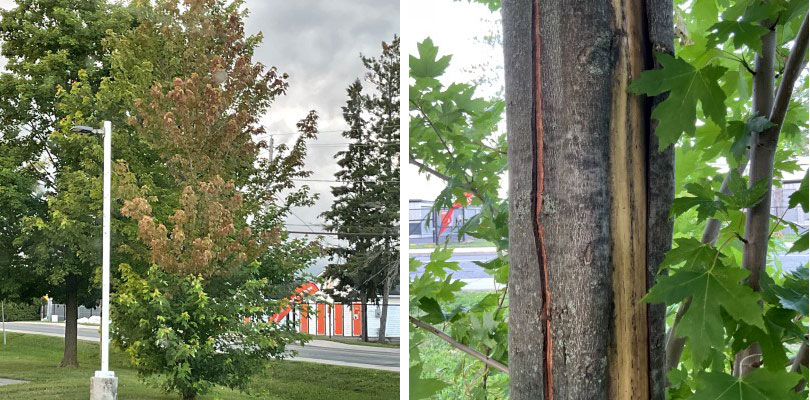
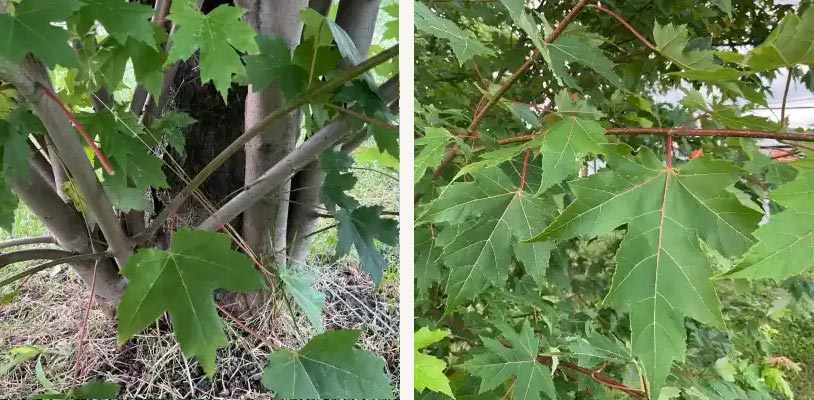
So with the dieback on top, the rootstock below ground, not being damaged, feels the need to be able to grow due to damage above, and has begun to send up suckers, which will not be similar to the reddening crown variety. It looks to be possibly silver maple, or even another variety of silver maple, known to be hardy. If left to grow, they could be trained into a new tree, guaranteed to be different from the other reddening hybrid.
So once again, there is another failing tree similar to all the others in town.
Alameda trees
A number of observant folks have also seen problems on our alameda, beside the library. You see some of the same, similar damage on those trees. They are all the same variety of sugar maple, called ‘Fall Fiesta’. The trees you see are also grafted, this time likely onto our native sugar maple.
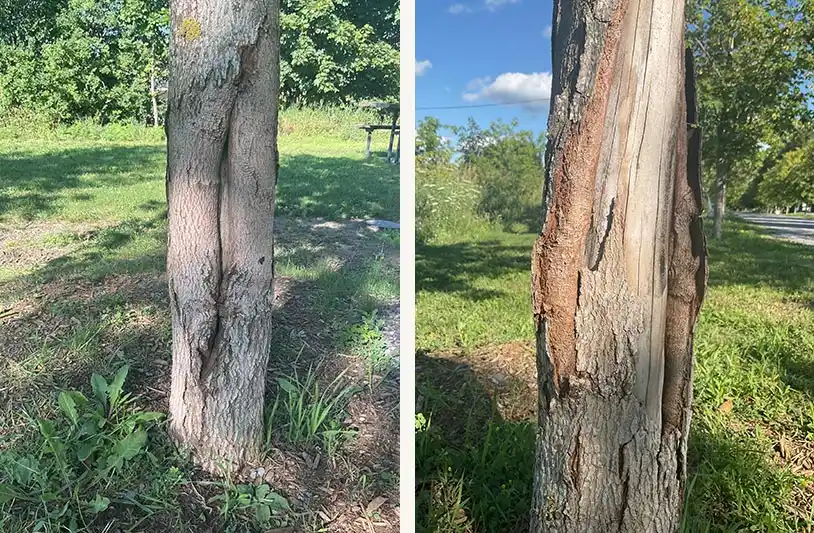
Here, the apparent problems vary, yet some of those that had split trunks are indeed “healing” over. They don’t really heal from the damage in a traditional sense; rather, new wood from the other side of the trunks has begun to grow around the damage, starting to close over the damaged sections. As these trees are still relatively young and fast-growing, it is hoped that most of the damaged ones will return to health and become strong specimens to create the canopy we envisioned. A few trees, however, are showing foliage changes as the red ones did, and most of those few will have a longer recovery period.
It is also very likely that the damage on the alameda trees was not a result of the same causes that damaged the reddening maples elsewhere in town, and that they will recover as seen in the photos.
Final thoughts
In closing, we can talk about trees forever. I’ve been doing it my whole career! They give us such diversity in our lives, and offer us so much pleasure AND essential aspects of life. We must not take them for granted, and we must care for them in the best ways we can.
But unfortunately too, horticulture is not just a hobby. It is a huge industry, and with industry comes the commendable necessity to make money. We all know too well that too many want too much, and as fast as possible. Trees being one branch (no pun intended, but funny anyway!) of this industry, which supplies new homes, developments, and cities, face the same pressures of supply. The faster they get them out, the faster they move on to new opportunities, and that being the case, it is indeed possible that corners are cut, or impatient decisions are made. As a consequence, PERHAPS, just perhaps, things are rushed too quickly. The reddening trees in our town COULD be a result of inefficient study time on a new variety, it COULD be a result of pushing a new variety into an overly unacceptable zone, it COULD be a result of inefficient genetic match on the new variety in question. We don’t know. Educated guesses, and thoughtful possibilities, may be our only answers, and a full study of this particular situation could take years… do we have that long?? The trees don’t.
***
The 2025 season was exceptionally dry. Trees requiring more water—such as those in poor soil or overall dry conditions—suffered greatly. The trees we are looking at here are under stress already, and the drought we experienced last summer would only have exacerbated the situation, showing just why tree selection depends on so many factors.
It is very likely also that many trees this year have been afflicted by “root embolism.” A situation caused especially by the very dry conditions experienced last season. Has to do with lack of water available to the roots, this causing an “air bubble effect” in the wood as it dries out seriously without water, thereby blocking the flow of nutrients and water to the canopy. That is another issue, but likely one that quietly occurs underground without our noticing, yet increasing the necessity to water landscape trees, especially in these dry seasons. Naturally, water supplies, such as from a well, must be carefully considered also.
