

by Edith Cody-Rice
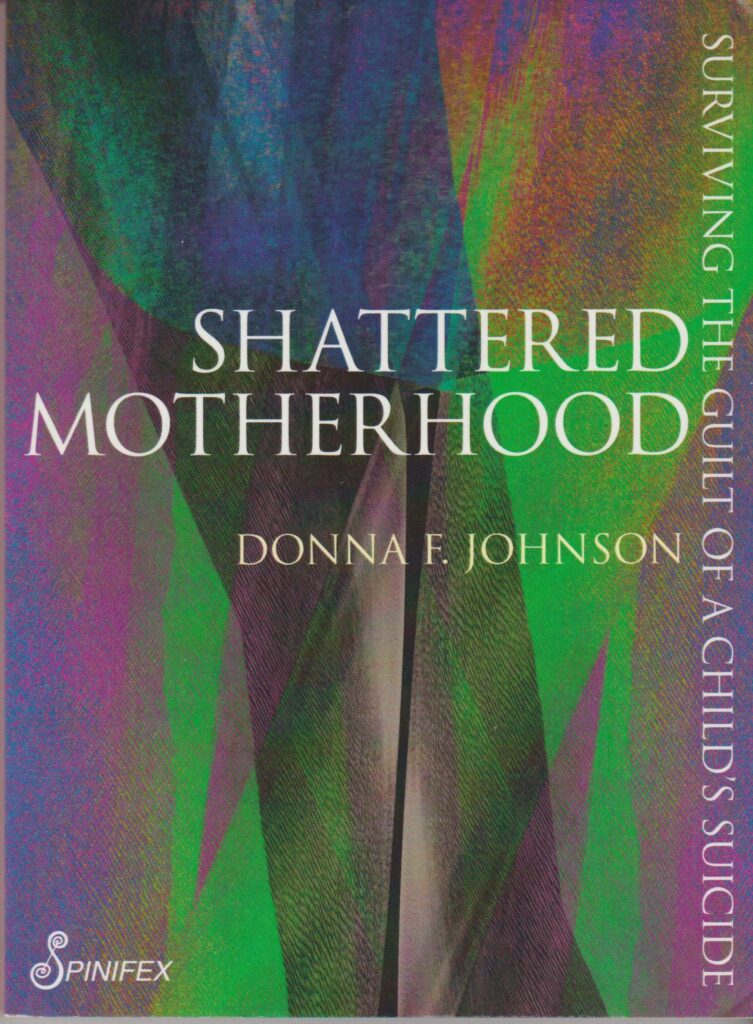
Imagine grieving for a loved one who has died. Many of us do not need to imagine that. We have lived it. Then imagine that that loved one is your child. Double the grief. Finally, what if that child died by suicide? The grief rises to a searing unbearable summit and is complicated by guilt. This is the subject of a new book by Donna Johnson.
The Shattered Motherhood of the title references the mothers of such suicided children. In the prologue to the book, Ms. Johnson sets out her most significant observation. She writes
For the mother of the suicided child, adding to her primal and persistent grief is an unyielding sense of culpability. A mother may spend the rest of her life atoning for her child’s suicide. She may not understand how she caused it but she believes in her heart that she did, suffers as if she did; as if she killed her child with her own hands, responsible by virtue of the fact that she is the mother and by dint of her personal failings as a mother. (p1)
Ashton resident Donna Johnson, who holds a masters degree in psychology, has worked for many years with battered women and in the mid 2000’s she was employed in the crisis unit of a Canadian police service. In that role, she supported family members who have faced trauma, abuse, homicides, accidents and in particular mothers whose children have died by trauma or suicide. In dealing with the mothers of suicided children, she began to notice a pattern among the survivors.
While fathers, stepfathers and siblings were usually able to get on with their lives after a time, resuming work, school and social activities, many of the mothers were immobilized. While others in the family felt a measure of guilt, the mothers were often ravaged by shame and self-loathing, viewing themselves as utter failures as mothers. p.6.
Time does not appear to heal in this case.
Through her work at the police service she discovered that the only thing that held out hope for these women was the company of other women whose children had died by suicide. When, at the urging of a mother, Ms. Johnson went searching for groups of these mothers she found that none existed so she created one. The support that they gave one another was the one thing that seemed to help, to relieve the guilt and profound sense of culpability
Ms. Johnson is a feminist – coming to that position through her own experience and through witnessing the treatment of women in our society, particularly battered women. She notes the patriarchy remains in charge and while the book starts with the mothers of suicided children Ms. Johnson extends her investigation to the broader female community.
Ms. Johnson began to be curious about women’s relationship to guilt earlier in her career, working at a shelter. It was the women, she says, the ones who fell traumatized and bleeding through our doors who felt guilty. (p98) The husbands felt justified and entitled, blaming their wives.
She explores this peculiar aspect of women’s experience through its origins and its effect on the family and on the institution of motherhood itself. She distinguishes the experience of mothering, a profoundly enriching experience, from the social institution of motherhood. Mothers, she posits, are subject to societal assumptions of selflessness and are held to a standard of unattainable perfection. Consequently, the mother is deemed accountable for her children’s lives, success and most importantly, their deaths. We live in a society where mother blaming is the norm.
And mothers are basically unsupported in society in their work they do for their children and the family. There are no days off, no medical or pension benefits for their labours as a mother, essentially little appreciation and a paucity of social support. They go it alone, doing the uninspiring work that underpins a family and goes largely unnoticed unless it isn’t done. Women themselves frequently accept this situation and the misplaced accountability placed on them when things go wrong.
This book contains many important insights into the condition of women and how that condition affects their lives. Ms. Johnson encourages women to look at their lives through realistic eyes. She concludes, giving examples, that society, especially the courts, and the larger community have all failed women, leaving them to take the blame for societal ills not of their making. But she believes the community of women themselves can prepare them to confront the inequities in a society that over values the male perspective.
Ms. Johnson uses the metaphor of the “hayloft”, from the 2023 Sarah Polley film Women Talking, based on a novel by Canadian Miriam Toews. In the film, the women in a remote Mennonite community, who have been sexually abused by their men, gather in the hay loft to discuss their situation honestly, without fear of retribution and to make decisions about their lives. In real life, the “hayloft” may be the kitchen or any other domain of women where they can gather without interference and be themselves and work to solve their unique problems.
Ms. Johnson treats her subject with wisdom, compassion and sensitivity. At the end of the book, she provides valuable advice on how to support the mother of a child suicide.
This is a small but important and insightful book and one that should be read by all women and those, like police and shelter workers, who meet them at their most traumatized.
Published by Spinifex
166 pages
Available in print form at the Ashton General Store
also available as an eBook.
