

Review by Edith Cody-Rice
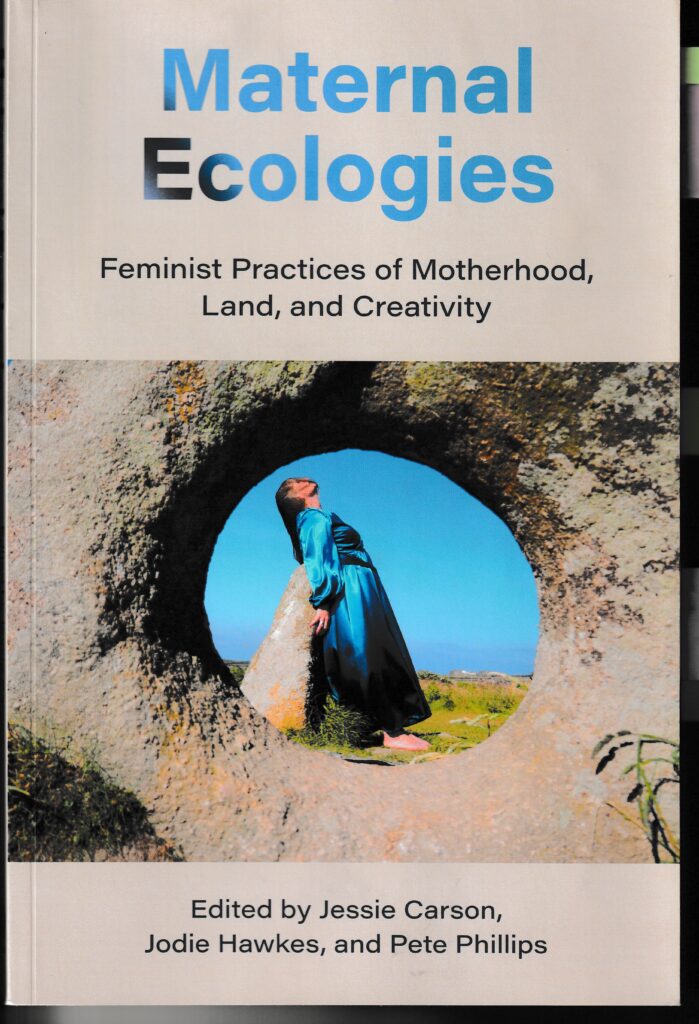
Maternal Ecologies is an anthology, a combination of artistic and academic expressions of the experience of motherhood, particularly in relation to nature and the land
In preparing this book the editors invited contributors from across the world.
In fourteen chapters from a wide range of disciplines including performance art theatre, visual art and social and cultural studies, the contributors explore a concept called matrescence first coined by Dana Raphael in the 1970’s and brought to the mainstream in a New York Times article by reproductive psychiatrist Alexandra Saks. Raphael wrote that during this process, this rite of passage, changes occur in a woman’s physical state, in her status with the group, in her emotional life… in her own identity.
In 2024, Lucy Jones an acclaimed science journalist and author, published a book called Matrescence based on her own experience of motherhood. Matrescence is described as a critical transitional period of “mother becoming”. Jones states that although we acknowledge a person’s transition into adulthood via adolescence, we do not acknowledge the transition into motherhood. She argues that despite the psychological and physiological significance of becoming a mother, how “it affects the brain, the endocrine system, cognition, impunity, the psyche the microbiome, the sense of self – the transition into mother hood is rarely, if at all acknowledged in Western Countries. In other words, the profound experience of giving birth and mothering children is largely ignored and may I add, frequently undervalued in our society. Women are expected to get on with their lives without fuss.
The book discusses this process from numerous experiences and points of view. Contributors come from across the Globe, from England and Ireland to North America and Hawaii.The experience itself is universal but how it is lived and described varies enormously. What is also universal though is how it is tied to nature and the earth. This is a through thread in the book and is described through dance, storytelling, ritual and academic study,
Jessica Roseman, a dancer, in her story “Magic in the Mess” states that in her dancing, she shares with her audience the unresolved tension of mothering that we don’t see glorified on television or magazine covers.
She says that mothers are often the ones stuck holding the mess. “We carry the sticky weight of life’s complexity and unpredictability, whether by necessity, expectation or circumstance. Mothers’ care is bound by physiology, guided by love and compelled by moral duty, all intensified by the life-sustaining demands of the role itself. “
A story that particularly moved me was the description of separation distress that can occur when a mother is away from her young child. I knew that there could be an experience of sadness and anxiety but I had absolutely no clue of the intensity, physical and mental, of this element of motherhood. The contributor, Lucy Tyle describes separation distress as the emotional or physiological symptoms that sometimes emerge following divorce or parental decoupling. According to Tyler, separation distress is a feature of contemporary life. In the context of the story, the author is a faculty member at the University of Reading and during her divorce, joint custody is ordered between her ex-spouse and her, all while she is still breast feeding her child. She experiences repeated vomiting and diarrhea the first time she has to leave her child with her ex-husband. It is not that she thinks he is a bad father, it is the experience of being separated from the child that causes this distress. Over time her hair fell out and she lost three stone (42 pounds) without noticing. During her limited time with her son she watches him in the university nursery obsessively from her classroom.
This is a book written from feminist perspectives, a valuable insight in to the elemental life of women, and one rarely discussed or appreciated.
Maternal Ecologies is published by Demeter Press
247 pages
Maternal Ecologies is available at Mill Street Books in Almonte or through your local bookstore
