

Part 2 in a series about Light Pollution, by Rick Scholes. See Part 1.
You may have noticed that lighting these days is often annoyingly bright. Glaring, one might say. Think of new vehicle headlights, or our streetlights, or even lights in our homes. If you look directly at any of these, and it’s hard not to, your ability to see anything else is impaired, and you are even momentarily blinded. In the lighting world this is the definition of glare, and it’s obviously not a good thing. Light should help our seeing, not impair it.
Glare is an aspect of light pollution. It has become an issue in recent years due to the introduction of LED lights. LED lights now dominate all major lighting markets – home, street, and automotive, and industrial – because of their superior energy efficiency. Glare is a result of the colour content, or spectrum, of “white” LED lights. Their spectrum contains an unnatural amount of blue light. It is this blue that causes glare.
The glare from LED streetlights, or the vehicle headlights, or the LED light installed outside your house is a safety problem, and an annoyance if it happens to shine into someone’s bedroom window. These lights are not necessarily brighter than before (though they may be), but they absolutely have more blue content. Blue light scatters more than any other colour. This is why our daytime sky is blue. At night, our eyes use the rod receptors (scotopic vision). Rods are most sensitive to blue-green, so a bluer light easily saturates them. That’s glare.
In 2017 the town of Mississippi Mills retrofitted all of its streetlights with the new LED technology. These lights are glaring but they are actually not brighter than what they replaced. I’ve measured them. In our municipality we are fortunate to have had an Outdoor Illumination Bylaw since 2003. It governs the intensity of streetlights. The old and the new lights all comply with the bylaw. However, the bylaw does not take into account the glare factor from LED lights.
The colour and glare differences between the new and old streetlights is very noticeable as seen in the photo below taken on King Street in Mississippi Mills. The LED is a cool blue-white. The older style high pressure sodium (HPS) light is a warm orange-white. (This particular HPS light wasn’t replaced because it’s on school property.)

Photo: R. Scholes (CC-BY-NC 4.0)
LED lights also add to light pollution in the form of skyglow. This is because any blue light scatters readily off of everything it encounters – pavement, grass, structures, humidity, even air. So even if the LED light is not pointed up, a lot of its blue light goes up into the sky. The new LED streetlights cause twice as much skyglow as the previous lights did.
A whole different problem related to LED lights is their proliferation. Their energy efficiency has caused us as a society to use more light. We now light up many things that do not need to be lit, because it’s cheap to do so. Decorative lighting has skyrocketed. Soffit lights on houses, decorative lights in backyards, and shoreline lights on lakes are sprouting like weeds. But late at night we don’t need to light up much apart from our roads. We never need to light up the sky. More lights than before and less motivation to turn them off leads to more light pollution. The efficiency gain realized by moving to LEDs has been offset by overuse.
Glare, light pollution, and overuse are all unintended consequences that have resulted from the LED revolution. Remedies involve choosing LED lights with the least amount of blue content, demanding more thoughtful lighting and fixture design, and reducing or eliminating unneeded artificial light.
Now let’s dig a bit deeper into some key aspects of lighting technologies, why LEDs have taken over, and what to look for if you’re interested in solutions.
A Brief History of the LED
Never did I imagine that light emitting diodes (LEDs) would evolve into a significant light pollution threat when, early in my career, I worked for a company that manufactured light emitting diode (LED) displays. In the industry we pronounced LED as “ell-ee-dee”, and not “lead” as in the metal; they don’t contain any lead. They do contain a semiconductor material that produces light very efficiently.
LEDs were invented in 1962. In the early days LEDs were good for making indicator lights and small displays that mostly came in one colour: red. Red LEDs were one of the technologies that made the first digital watches and calculators possible. Green and amber LEDs were also made but were less manufacturable. None of them were bright enough to light up a room.
In 1993 a breakthrough led to the creation of blue LEDs. This was a game changer since by combining blue, green, and red, any other colour can be made. White light LED sources soon followed soon in 1996, though it took another 20 years of development for them to become affordable for widespread use. Since the mid-2010s the prices have dropped dramatically, leading to market dominance.
LEDs have intrinsically long lifetimes. Over time they slowly decrease in brightness but don’t generally fail by burning out. They’re small and compact. They are very energy-efficient because they operate on low currents and voltages.
Efficient, long lifetimes, and tunable colours – no wonder they dominate the market.
Differences with older technologies
Incandescent light bulbs were the standard residential lighting technology for a hundred years. They were glass bulbs containing a thin tungsten filament that glowed white hot when energized. They are inefficient because they emit more energy as heat than light. The bulbs typically burned out after 1000-2000 hours. The new LED light bulbs typically need about 15% as much electricity, and will last ten to fifty times as long.
High pressure sodium (HPS) gas discharge lamps were the predominant technology used for streetlights in North America. They emitted an orange-tinted white light as seen in the photo above. The new LED streetlights typically need about 25-30% of the electricity and their lifetime is predicted to be 12 years or more (based on an 11-hour operating day). Both factors are considerably better than HPS.
The glass lens that contained the sodium vapour in an HPS streetlight protruded down so that the fixture resembled the head of a cobra. This contributed to light pollution because the lens emitted light sideways and upward as well as downward. An advantage touted for LED streetlights is their “full cut off” housings, which prevent any light from going directly upward. But as mentioned above, the blue component of these lights readily reflects or scatters in all directions off of whatever it encounters, which negates the “full cut-off” advantage.
Colour Temperature and Spectrum
Colour temperature is the parameter used to define the hue of a light source. Incandescent lights used to come in two general hues: “bright white” (called “daylight” by some manufacturers) and “soft white” (also called “warm white”). The former were usually used in kitchens, bathrooms, and workshops, where good detail and colour vision were needed. These had a colour temperature of 4000K – 5000K. The latter were preferred in living areas and bedrooms, as they were yellower and easier on the eye. They had a colour temperature 2000K – 3000K. The colour temperature is marked on light products now but it wasn’t always. Higher colour temperature means bluer, lower means yellower. (Just like a hotter flame is bluer and a cooler one is yellow.)
How does a white LED produce its light? Surprising as this may sound, there is actually no such thing as a white LED! For commercial reasons most “white” LED lights are made by coating a blue LED with a phosphor material. Some blue passes through the phosphor, while some is converted to yellow, green and red. Even though the net result is white, LED lights unavoidably contain a lot of blue.
To see how much blue we must look at the light’s spectrum, which shows the relative amounts of colour present. In the figure below, LED and incandescent lights are compared.
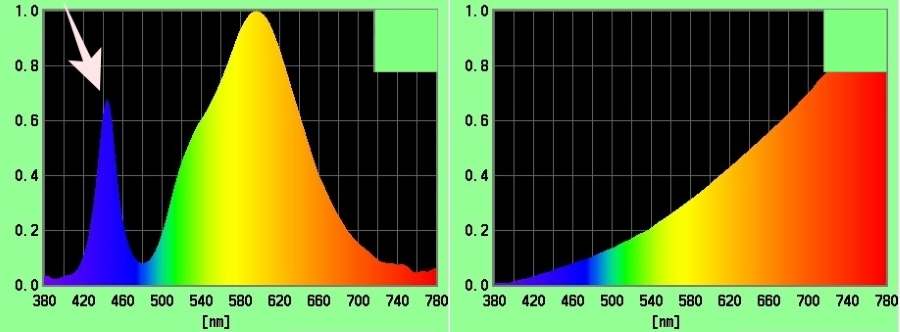
Image credit: R. Scholes (data gathered with a Sekonic C-800 spectrometer)(CC-BY-NC 4.0)
The LED light has a characteristic blue peak (arrowed) which is never present in incandescent or HPS lights. The higher the colour temperature, the larger the peak. More importantly, an LED light always has far more blue content than an incandescent or an HPS light even if the colour temperature is the same. Thus, replacing 3000K HPS lights with 3000K LED lights on our roads has caused more light pollution.
Solutions
LED lights are here to stay. Light pollution and glare can be reduced by choosing lower colour temperature LEDs: 3000K is okay, 2700K is better. The relatively recent appearance of 2700K LED lights has been driven in part by consumer demand for warmer lights. That’s good news. The technology continues to evolve. LED lights around 2000K are now available, quite orange in appearance but containing nearly no blue.
Office building lights, store lights, porch and garage lights, and the multitude of decorative lights are often left illuminated because they’re perceived as costing only pennies to operate. People simply don’t give it much thought. In most cases they could be dimmed or switched off much of the night. Groceries rarely get cheaper, nor do electricity rates. But we have the option to turn off any light when we go to bed and save some money that can be put towards more important things … like groceries. Think of it like using a loyalty points card: it adds up.
We need a counter-revolution in order to reduce the amount of light we use and to move towards those with less blue. Reducing light pollution will benefit us and all our planet Earth companions as well.
Part 3 of this series, “The Night Sky: The Birds and the Bees”, will review some of the more and lesser-known effects of light pollution on the ecology.
