

by Vince Marquis
Probably the most recognized use of the name “Ebenezer” is that of Ebenezer Scrooge in Charles Dickens’ immortal Christmas novella of 1843, A Christmas Carol. Almost everyone still following the remnants of the Euro-based celebration of the Christ-child’s birth, at least in North America, will view or listen to some version of Dickens’ literary masterpiece during the Christmas season, or some derivative form of it which “cashes in” on the timeless theme of the story.
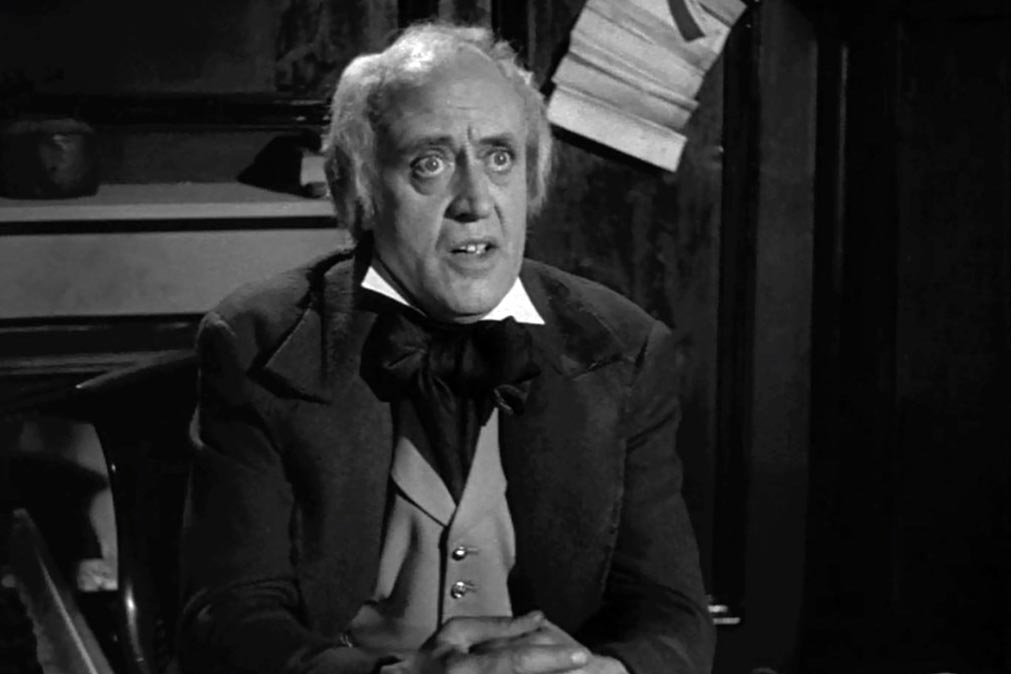
Perhaps the most recognizable children’s adaptation is Dr. Seuss’s How the Grinch Stole Christmas and its myriad portrayals in movies and on TV streaming services. But, to my mind, the best of all Scrooge portrayals remains the 1951 black-and-white British production, “Scrooge”, starring Alistair Sim. His “Ebenezer” is the quintessence of Dickens’ original character, and takes us into the time and culture of that period far more effectively than anything that has been offered since. It also pays proper dues to the real sense of Christmas and why we celebrate it at all anymore.
As to the “Christian” name of the protagonist of the story, Ebenezer, Dickens chose it quite deliberately. It is derived from the Old Testament, and was not the name of a person, but of a monument erected by the Israelite seer-prophet Samuel to commemorate God’s direct intervention in a crisis. The story can be found in the Biblical book of 1 Samuel, chapter 7, verses 2-13. The name was given to a pillar to honour God’s help in gaining a smashing Israelite victory over their arch-enemies and primary oppressors, the Philistines. Ebenezer is Hebrew for “thus far hath the LORD helped us.”
Until recently, if someone was labelled a “Philistine”, this signified someone unworthy of respect, someone common place, uneducated but pretending to be what they are not. It could also imply someone who took pleasure in mocking God and those who tried to live a moral life. To the Israelites, the Philistines were much worse than that – they were powerful, pagan foes who mocked them and their invisible God whose name the Israelites dared not even pronounce. They despised the Israelites as weak, of no account, and of no culture.
Israel’s ragtag militia-army came out to fight them at Mizpah around the year 1050 BC, after recently recovering the Ark of the Covenant, which the Philistines had held for forty years after Samson’s death. The Philistines’ not unreasonable expectation, especially given their technological superiority of iron weapons, chariots, and iron armour and bronze armour versus whatever the Israelites could scrape together, was that they would once more crush their hill-country rube neighbours. They confidently assumed that they would, as per usual, kill thousands of them, enslave thousands more, and gather great booty to divide among their five cities.
Instead, against all odds, after the Israelites fasted and prayed and beseeched Samuel to intercede for them with the LORD as they took the field, there was violent thunder and lightning which sent the Philistines into a great panic. They assumed that Israel’s fabled invisible warrior God was taking the field with His people. The Israelites wreaked a great slaughter on their enemies. That is why Samuel raised a pillar and named it “Ebenezeer”.
Ancient battles were bloody affairs with multi-thousands perishing in a few hours. This no doubt sounds excessively gruesome to squeamish modern ears where we are much more accustomed to not seeing the whites of your enemies’ eyes before you press the button that sends in the drones and smart bombs, or press the trigger that sends a stream of red-hot bullets by the hundreds in the space of seconds. The “enemy” is usually out of sight – except after you have to move in to clean up the horrid aftermath and see what these sophisticated killing machines actually do. So let us not be too smug about our impersonal and long-distance execution of our enemies, never having to witness their humanity close-up when you thrust the spear into his guts or lop off an arm with a sword slash. Let us not turn up our smug noses at these ancient “barbarians” who had to measure themselves man-to-man and eye-to-eye and lay their lives on the line every bit as dramatically as the soldiers of the 21st Century, but with no way to excuse what they did by depersonalizing the all-too-visible individuals lined up opposite them.
So, who is Ebenezer Scrooge? A caricature? A straw-man? A stereotype? An enemy to be taken down?
Certainly, Dickens presents us with a stereotype of the ruthless businessman of the cutthroat capitalist type, doing obeisance to the great god Mammon. Of Mammon, Jesus, the grown-up Christ-child, had said, as Dickens and any moderately educated person of the 1840s knew, “You cannot serve both God and Mammon (Money).” Before he said that, he had said, “You cannot serve two masters, for you will either love the one and hate the other, or honour the one and despise the other.” He had even more excoriating things to say to religious hypocrites.
Mammon was a personal name for money, signifying an active demonic presence in the ruthless, conscienceless pursuit of wealth by any strictly legal means, regardless of its manifest immorality and lack of concern for the welfare of the poor and destitute. “Gentle Jesus, meek and mild” is a deliberate obfuscation and distortion of the real man, the real Son of God. He said hard and sometimes harsh things when it was needed, especially to those who held power and influence and used it to control and manipulate the lesser beings beneath them. On the other hand, he was full of grace, compassion, and mercy for those who were cast out, depersonalized, despised, etc.
So how about our Ebenezer? Yes, he is a bit of a stereotype, but I would suggest more of an archetype. He was a hard, ruthless, pitiless, compassionless man. He had reasons for how he had evolved – he could list, rationalize, and excuse them all.
As an adult, Dickens was not a fervid churchgoer, although he maintained a deep affinity for Christian moral values due to his devout Anglican upbringing. He lived in a culture steeped in the Bible and its metaphors, and knew that love and grace and mercy are of far greater value than any amount of literal wealth. He was very conversant with the Bible and had a deep conviction that it teaches a core story of human failing and brokenness, of mankind in need of redemption. He knew that the Christmas story, at the very least, is the central tale of God opening the door to that through the humblest and most unlikely source – a seemingly ordinary baby born to a poor couple of no apparent account in their, or any, culture. But, if there is a God, a real God, that is how He would appear, not as the great conquering hero ready to rinse and repeat the cyclical tale of yet another all-conquering militarist slaughtering and pillaging and coercing the world into submission.
Ebenezer is given an unmerited gift of pure grace, for that is what grace is. He is allowed to see the path he has taken in his past up to that Christmas Day of 1843 – a path that is on the broad road to destruction, as Jesus described it in another analogy. He is shown that there is still time to choose another way. Overwhelmed, he takes it and is reborn, a new man.
He himself becomes a living Ebenezer, a live pillar declaring, “Thus far has the Lord had mercy on me and poured out his grace on me. Here I stand, a sign of his presence and mercy to any who will look and see.”
