

by Jim Moore, Almonte
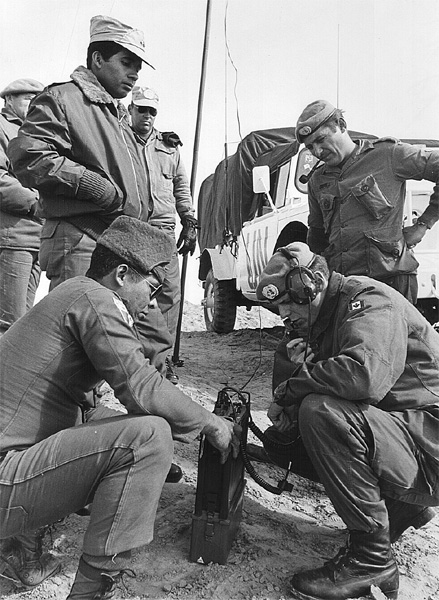
Remembrance Day November 11 gives me an opportunity to reflect on my military service of so many years ago. I was particularly fortunate during my time in uniform to serve with the United Nations Emergency Force (UNEF 11) for six months in 1976.
By way of background, UNEF 2 was deployed after the Yom Kippur War in October 1973 to supervise the cease-fire between Egypt and Israel and to monitor troop withdrawals.
This was the fourth Arab/Israeli conflict. The combatants were Israel versus Egypt and Syria. The war began with a surprise attack by Egypt and Syria to regain territory lost in 1967. During that previous war, Israel had captured the Sinai, Gaza, the West Bank, including east Jerusalem, and the Golan Heights.
In the 1973 conflict Egypt and Syria had launched a coordinated surprise attack on Israel during the Yom Kippur holiday. Their objectives were to regain the Sinai Peninsula and the Golan Heights. In the early going, the Egyptians crossed the Suez Canal into the Sinai, with tanks and troops and using surface-to-air missiles. Israel was caught off guard and suffered significant tank and troop losses. On the Syrian front, there was an overwhelming assault on the Golan Heights and heavy artillery and tank engagements inflicted early Israeli loses. Israel eventually stabilized both fronts and then counterattacked and eventually encircled the Egyptian Third Army and pushed the Syrian army back to pre-war lines. The Israelis lost 2800 soldiers and the Arabs 8500 soldiers in this conflict.
Both sides agreed to a UN-brokered cease-fire, which resulted in the largest UN peacekeeping operation in history. This operation was conducted from 1973 to 1979. At any given time Canada had approximately 500 troops on the ground based at Ismailia Egypt, and on the Golan Heights. By 1976,the Canadian Contingent in Ismailia was composed primarily of personnel from Ontario bases- Petawawa, Borden,Kingston, Trenton and Ottawa- supplemented by smaller detachments from Chilliwack and Gagetown.
Other countries were involved as well, including during my time there, Finland, Poland, Sweden, Ghana, Senegal and Denmark. Their primary duties included observing the cease-fire compliance, patrolling the buffer zones and providing humanitarian and logistical support.
… It’s September 1976, nearly 50 years ago. I was a young Army Captain in the based at CFB uplands (Ottawa). Married with two small children living in PMQs at Rockcliffe Air Force Base.
… One day early in September 1976 I I was summoned to the Base Commanders Office. He said… ” better pack your bags”- HQ was plucking troops from Bases across the country to serve as United Nations Peacekeepers in the Sinai Desert. The idea being to enforce the cease-fire agreement between Israel and the Arab nations, following their fourth war popularly known as the Yom Kippur war fought in 1973. I was being posted without my family to 73 Canadian Service Battalion based in Ismailia Egypt, near the Suez Canal for a six month tour of duty. When I inquired as to what my specific duties would be I was told I would find out when I arrived in Egypt.
… Sept 15, 1976. I am aboard a Canadian Forces flight from Trenton Ontario to Lahr Air Force Base in Germany. From there to Cairo and from Cairo, we headed north by UN vehicles through Port Said to Ismailia. We were greeted by a six-day dust storm. The dust and sand permeated everything for days on end. After that I think the sun shone for every day until my tour ended.
… Assigned the duty of Battalion Logistics Operations Officer- a fancy title, my responsibility essentially involved getting food and a wide range of provisions across the Suez Canal and into the Sinai desert without mishap in order to maintain other countries operations in the buffer zone. Most of that time I/ we spent playing “ give and take” with the Egyptian Army. Our engineers would deploy mobile bridges across the Suez Canal during the day to enable Canadian and Polish UN trucks to cross into the buffer zone. At night the Egyptian Army would take one or more out and place them on the banks of the Canal to slow our progress in getting supplies to the Un Peacekeeping Nations. A not so subtle game of chess.
…memories of intense heat during the daytime. We worked outdoors daily from approximately 6 am to 1 pm . Most afternoons spent indoors in prefab buildings with air cooling apparatus. Weekly we could speak to our loved ones back home via shortwave radio. There was an Egyptian barber on our base. A haircut and shave cost 25 cents. Most of our food was flown in from Germany to Cairo and then trucked to our base. Occasionally we would access fresh veg and fruit in Sharm El Sheikh Egypt.
… had a chance during my tour to visit Damascus ,Cairo and Tel Aviv. Flew to these locations in a UN aircraft. I recall being buzzed by Russian MiG fighters. The Russian regime was ambivalent about UN peacekeepers being on Egyptian soil. Traffic in Cairo was truly chaotic. Outdoor markets in Damascus were tremendous. Tel Aviv incredibly beautiful. The people in the streets there always on alert and very anxious about the possibility of another war.
…drove to most parts of the Sinai. Met with counterparts from the other countries scattered at various strategic locations where hostilities were most likely to break out. I remember how cold the desert became at night. We would turn off the Jeep lights in the middle of nowhere and watch the night sky. Incredible to see so many satellites cris crossing in the clear black night sky.
Came across Nomad encampments from time to time. Learned to detest their camels which would hiss and spit and try to chase our jeeps out of the area.
…..Was amazed to see the extent of destroyed military hardware strewn across the desert. Both Arab and Israeli. Burned out military tanks on either side of the asphalt highway that the Israeli’ military engineers put down in record time to cross the desert and engage the Egyptian and Syrian forces particularly around the Mitla Pass where heavy fighting took place. Overall Israel lost 800-1000 tanks destroyed and the Arab Forces lost 2000-2500 tanks destroyed or captured.
