

by Brent Eades
What Is Alto?
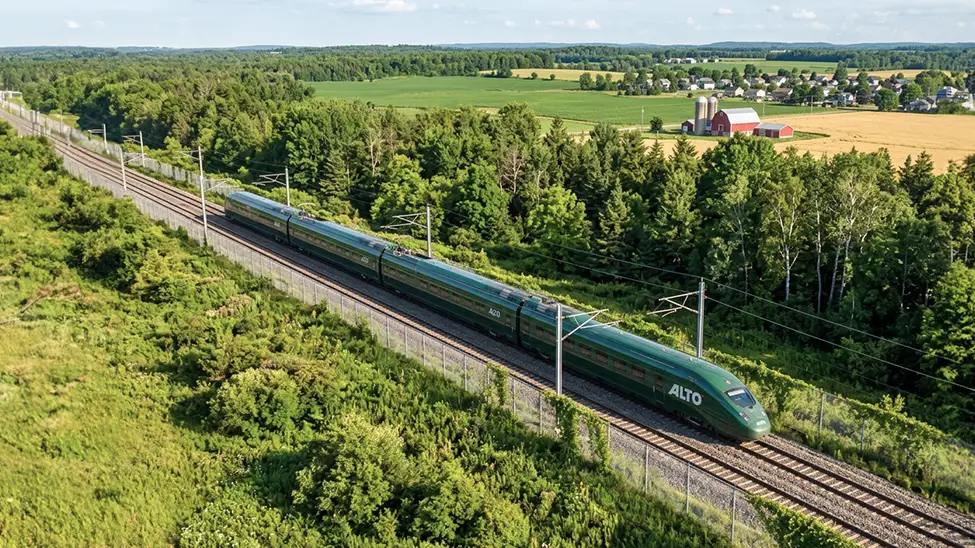
Alto is a planned high-speed rail network running from Quebec City to Toronto, announced in February 2025. Its trains would reach speeds of 300 km/h or more on about 1,000 kilometers of newly built electrified track, apparently cutting current rail trip times in half.
The design phase could last up to five years and cost $3.9 billion, while actual construction costs are estimated at a staggering $60 to $90 billion.
A Wikipedia article says the project will be complete by 2043, but Alto’s website says only (and vaguely), “The precise alignment and related timelines are being developed. There is no specific launch date yet for the full alignment. As work continues, a clearer picture of a projected window for operation will develop.”
Who’s behind it?
Alto is a public-private partnership with several layers.
In March 2022, the federal government authorized VIA Rail to incorporate Alto as a wholly owned, arm’s-length Crown corporation, and then began the process of choosing a private sector partner to actually build the network. The winner was Cadence, a consortium made up of SYSTRA, CDPQ Infra, Keolis, SNCF Voyageurs, Air Canada and AtkinsRéalis.
Notably, AtkinsRéalis (formerly SNC-Lavalin) was and is responsible for key aspects of building Ottawa’s problem-plagued LRT system, which has seen numerous technical failures and missed deadlines, plus costs climbing far beyond original budgets. So far fewer than 40 km of track have been completed—a fraction of Alto’s 1,000 km network.
Why does the federal government think we need it?
That’s the $90 billion question.
The most compelling case the government makes for Alto is economic growth—purportedly up to $24.5 billion worth a year through direct job creation and softer benefits such as decreased travel time and increased productivity. The vision is of an economic “mega-region” stretching from Quebec City to Toronto, an area that holds nearly half of Canada’s population.
Such rosy forecasts may turn out to be accurate, I suppose, but the chequered history of past “nation building” projects suggests otherwise. More on this below.
Why does this matter to Mississippi Mills?
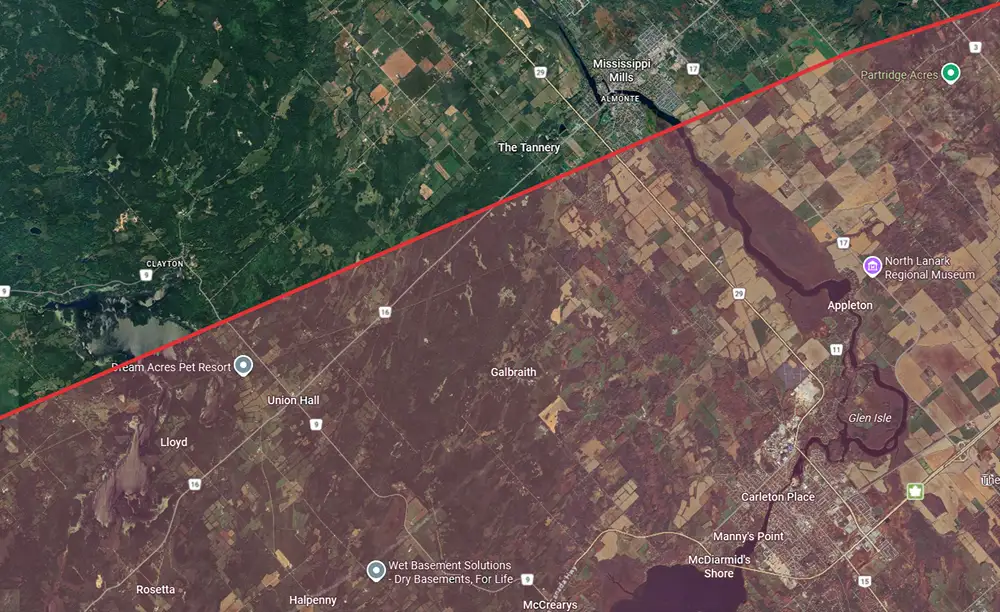
Because no one knows yet exactly where long stretches of Alto will be built. But it could be right here.
While the approximate Alto routes from Quebec City to Ottawa and Peterborough to Toronto are known, two different options are being considered for the Ottawa to Peterborough stretch—the northern and southern. The northern route could cut through a sizable chunk of Mississippi Mills and other parts of Lanark County.
As for why two routes are being considered, Alto says that high-speed trains need the straightest route possible: “The more curves you have, the more the train has to slow down.” The northern route is the straighter of the two, though it would also have to cut through 85 km of Canadian Shield granite.

What could the impacts be?
You may be thinking that we’ve had trains and tracks in Lanark County for over 150 years and we’ve mostly coexisted well enough.
Traditional railways were built to connect communities along their routes, with branches and spurs radiating from larger to smaller towns. They accommodated existing roads with level crossings or overpasses, and if they had to traverse a farmer’s fields, the tracks could easily be crossed.
Alto is different. Because these trains will travel at 300 km/h, the entire corridor must be “grade-separated” and fenced off. This isn’t just a track; it’s a permanent wall. Road crossings have to be largely eliminated; if the track crosses a concession road, it will likely be cut into two dead-ended halves. If it bisects a farm, that too will likely be cut into halves, with no access from one side to the other.
Alto responds
Alto CEO Martin Imbleau acknowledged that some roads would become dead ends but that crossings would still be provided: “Probably underpasses in farmlands and overpasses in other places.”
In an interview with the CBC Imbleau said, “It’s thousands of crossings that we’re talking about… In some communities we will have to move roads because the train cannot stop.”
But Lanark-Frontenac MP Scott Reid, a vocal opponent of the project, said in a speech to the House of Commons, “As a practical matter, installing literally hundreds of bridges or underpasses… would cost billions of dollars. Since the project is already projected to cost $60–$90 billion, it is likely that one cost-saving measure would be to have as few bridges / underpasses as possible.” He said that “it is far more likely that most such intersections will be dealt with by creating dead ends, and that only major roads will receive an overpass or underpass.”
Too few stations
Currently, Alto is proposing only seven stations along its 1,000 km route, four of them in Quebec. Ontario would see stops only in Toronto, Peterborough, and Ottawa. For the rest of us, the math simply doesn’t work. If you don’t live near one of these cities, you’d still have to drive an hour or more just to reach a platform. By the time you’ve navigated highway traffic and paid for station parking, you might as well have kept driving to your destination.
Expropriations are on the table
In the CBC interview Imbleau said that land could be expropriated if necessary. “We will need to buy significant pieces of land, so we’re talking about thousands of properties. That process will probably start in 2027. If people are reluctant, there is of course some recourse with the expropriation process that could happen. But really, the intent is to have willing seller/willing buyer agreements in due time.”
A Senate report last month said that “Canada has a troubling track record of expropriating private land for major infrastructure projects that were later cancelled, substantially scaled back, or that failed to deliver on their promised purpose,” citing the Mirabel and Pickering airports, the Spadina Expressway, and the clearance of Ottawa’s Lebreton Flats area. It said that such projects “reveal consistent patterns: overstated demand projections, political momentum that overrides landowner rights … and communities that bear generational consequences long after governments quietly abandon the projects that justified the taking.”

Mayor and Council’s response
In a mid-March Facebook post Mayor Lowry outlined her initial concerns about Alto’s potential impacts on Mississippi Mills:
- Impacts to roads, emergency response, and municipal services
- Impacts to recreational trail systems
- Impacts to watershed systems
- Drainage and water management impacts
- Conflicts with long-term land-use planning throughout our municipality but specifically in Almonte, Appleton, and Clayton
- Risks of orphaning parts of the municipality and isolating farm parcels
- Lack of tangible benefits and weak community benefit package for communities hosting the corridor
- Potential negative impacts on local tourism, economic development, and rural transit
The issue was discussed at the March 10 and March 24 Committee of the Whole meetings, where staff were directed to submit feedback and technical comments to ALTO about the potential municipal impacts. A formal resolution and accompanying letter, based on the Eastern Ontario Warden’s Caucus position, are being developed and will be presented at the April 14th Committee meeting.
On March 30 Mayor Lowry sent a letter to Scott Reid, reiterating and expanding on the concerns raised in her earlier Facebook post.
What can we do about this?
Alto is soliciting public feedback on the route options until April 24. The most useful mechanism is an online map where you can add comments about the potential impacts on specific parts of the possible routes:
There is also an online survey, though I’m not sure how useful that might be. The online map seems more likely to give Alto planners hard information about the potential impacts of a route in our area.
I should also stress that neither the municipality nor the province has any direct influence on the final decision. While you’re welcome to share your concerns with your councillor or our MPP John Jordan, the decision isn’t theirs to make. This is a federal initiative.
MP Scott Reid has launched an online petition against it.
Final thoughts
Politics is a cynical business, where decisions are often driven by calculations of potential votes gained against votes lost. Electors in the seven cities Alto would serve represent about 70 federal ridings, and they will likely have few objections to the project—not if it promises faster travel and expanded business opportunities, while bringing minimal disruption to their cities.
The northern route—where Alto could lead to expropriation, severed farms, bisected roads, disrupted watersheds and trails, and harm to municipal and emergency services—contains only two full ridings and perhaps portions of two others. That’s compelling electoral math for a politician.
Federal governments have always used “nation building” language to override local objections to large infrastructure projects. The CPR dispossessed Indigenous peoples and Métis communities. The St. Lawrence Seaway flooded entire villages. The Mirabel airport fiasco expropriated 97,000 acres from Quebec farmers who never saw the promised benefits. In each case, the national interest was defined by and for the urban majority, and rural communities were told their sacrifice was patriotic.
This seems to be what Alto is telling those of us who live in the rural regions that city-dwellers will rush through on fenced tracks at 300 km an hour: “Sorry about the massive disruptions this could cause you, but it’s for the greater good.”
It’s not good enough for us here in rural Ontario that I can see. Not unless the very real concerns about the harm it could cause and the absence of any benefits to us are addressed.
