

By Sandy O’Hara
The following report on the history and significance of the Pinehurst property was submitted to the Heritage Committee April 1, 2026.
For further information on the proposed development of the Pinehurst estate, please see the previous Millstone News article.
Statement of Significance: Pinehurst was the residence of Bennett Rosamond, a major mill owner in Almonte. It is known for its architecture, striking design, originality and uniqueness, being one of few residences designed by Henry Langley in this part of Ontario, and most importantly, it remains standing on its original footprint. The estate, standing on its original footprint, spans 10 acres along the Mississippi River and is characterized by two private waterfalls.
Pinehurst’s unique architecture, location and history merits protection through heritage designation. No changes have been made to affect the site over the years. Designation will be sought for Pinehurst, including the buildings and property.
The Pinehurst Property
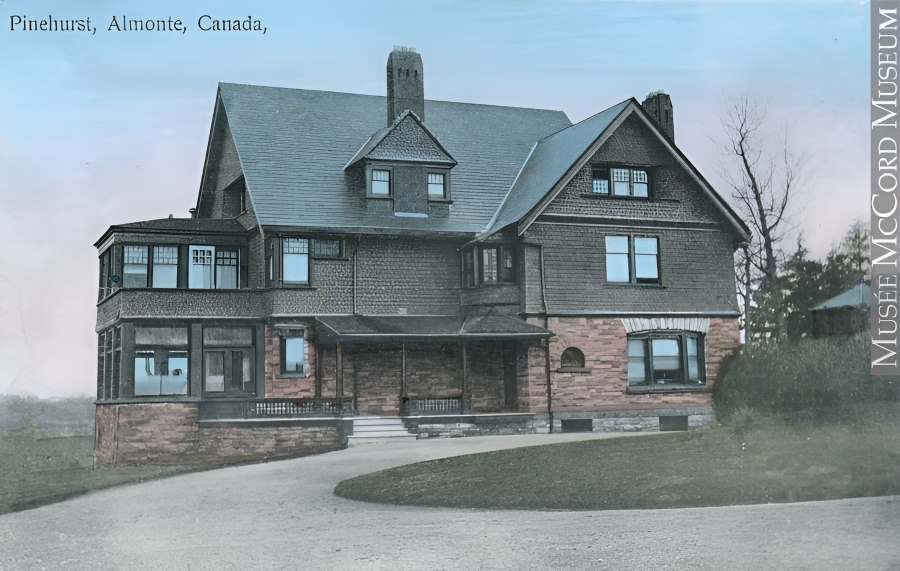
The Pinehurst property was once known as Brookdale Park. The historic waterfront residence was built in 1890 by Bennett Rosamond, owner of the Rosamond Woollen Mill, one of the largest textile mills in Canada.
Following his death, Pinehurst and the mill passed to his nephew Alexander Rosamond.
Over the ensuing years Pinehurst has been graced by visits of many famous Canadians including two Governors General. The main Pinehurst house measures 7500 sq ft and features grand reception rooms, eight bedrooms, seven bathrooms and 10 fireplaces, with many retaining original features, including woodwork and stained glass. The exterior boasts rocky islands and a grand sloping lawn. Pinehurst serves as a notable example of Victorian-era industrial wealth.
The library was once the office of Bennett Rosamond who served as a Conservative Member of Parliament when Sir Wilfred Laurier was Prime Minister.
The Pinehurst carriage house was used by R Tait McKenzie as a temporary studio and is where he created the bronze statue of “The Volunteer,” which forms the stunning centrepiece of Almonte’s War Memorial. Alexander Rosamond’s widow commissioned the statue. Alexander Rosamund died near the Battle of Ypres in 1916.
Pinehurst carriage house where Dr Tait McKenzie created “The Volunteer” sculpture.
Almonte is a community renowned for its well-preserved 19th-century architecture and history as a textile hub. Frequently used as a filming location, Pinehurst has featured in over a dozen films and in the 21st century often referred to as the “Downton Abbey of Almonte”.
Community context

Rosamond homes have cultural significance in Almonte because of their owner’s importance to 19th and 20th century commerce in the area.
The well-known Canadian architect, Henry Langley, designed Pinehurst. Houses of this design and style are rare in this region.
Architectural Information:
- General Statement
- Architectural Character: typical of the late Queen Anne style, reflective of artistic, non-traditional homes of the period c.1880 – 1910
- Condition – good
- Description of Exterior built of Perth sandstone, trimmed with Nova Scotia sandstone and roofed in slate; on 10 wooded acres, gate house/lodge, carriage house; greenhouse/grapery added in 1894; cost of $20,000.
- Overall Dimensions: 7500 square feet
- Foundations stone
- Wall Construction, Finish and Colour: Nova Scotia red sandstone and Perth white sandstone, half-timbered on red-grey clay tiles, cedar shake shingles, original slate roof.
- Porches: cedar shakes on enclosed porches on first and second floors.
- Chimney: three each with several flues.
- Roof: original slate.
- Description of Interior: grand foyer with imported English tiles, handcrafted wood ceiling, sweeping staircase with spindle work; marble fireplace, crown moldings, stained glass, wall and floor ringer system for staff; Bennett Rosamond office built-in desk, wood paneling, fireplace and pocket doors; sunroom and patio with views of river, waterfalls and forest.
Documentary Evidence
The ownership history of Pinehurst, 39 Carss Street, Almonte, spans from its construction for a prominent local industrialist to its current role as a private residence.
Original and Subsequent Owners:
David Shepherd purchased the land from the Crown in 1823. He sold the land to Daniel Shipman in1839. Shipman then sold the land to the Postmaster of Almonte, James Wylie, in 1854.
James Rosamund of Carleton Place built the Woolen Mill which was leased in1862 by Bennett Rosamond under partnership of Bennett and William Rosamund, who then bought the Pinehurst property in 1883.
- Bennett Rosamond (1890–1910): Pinehurst was built in 1890 for Bennett Rosamond, president of the Rosamond Woollen Company, which operated one of Canada’s largest textile mills. Bennett Rosamond was also a Conservative Member of Parliament.
- 1910 – 1952: The Rosamond Family
The estate remained in the Rosamond family following Bennett Rosamond’s death in 1910. The Rosamond family’s ownership of the property effectively ended in 1952 when the family sold their remaining mill interests. - Late 1950s – 1970s: The Taylor Family
John and Mary Taylor owned and resided in the manor during the late 1950s, 1960s, and 1970s. The house became a well-known community hub during this era, hosting numerous events while the Taylors raised their five children there. John Taylor served as Vice President of the Ashton Press Manufacturing Company. - The Rebin family owned the property from the early 1970s until 1996.
- Keith and Penny Blades owned the property from 1996 – 2009 before selling it to the Ashby family.
- Patrick and Dee Ashby (2009– present): Patrick Ashby, who grew up nearby and mowed the Pinehurst lawn as a teenager, purchased the estate in 2009.
- As of 2026, Patrick Ashby (through 2607129 Ontario Inc.) is listed in municipal planning applications as the owner of the 39 Carss Street property for proposed residential developments.
Historic Context
- Date of Construction of Pinehurst: 1890. Bennett Rosamond purchased the land in 1883, locally known as The Point or Brookdale Park.
- Architect: Henry Langley of Langley & Burke Architects, Toronto
- Alterations and Additions: None
- Historical Events and Persons connected with the Structure: R. Tait McKenzie sculpted The Volunteer, featured in the Almonte cenotaph.The artist stayed and worked in the property’s coach house.
- Bennett Rosamond was the Reeve and Mayor of Almonte, and Conservative MP for Lanark North, elected in 1891, re-elected in 1896 and 1900.
- The Brockville – Ottawa railway (which ran by the edge of the property) had reached Almonte in 1859, with regular service operating by 1860.
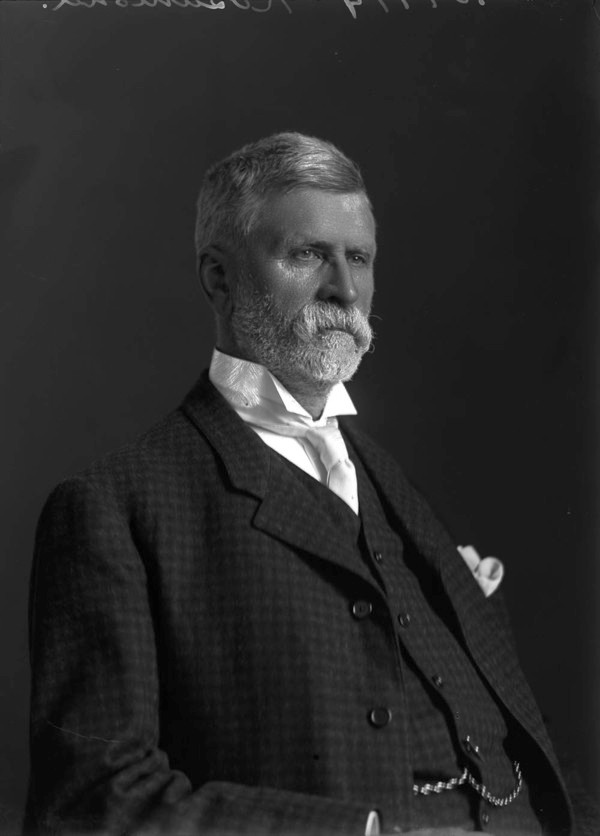
Bennett Rosamond (May 10, 1833 – May 18, 1910) was a Canadian manufacturer and politician.
Born in Carleton Place, Ontario, the eldest son of James Rosamond and Margaret Wilson, Rosamond was educated at the grammar school in Carleton Place. He was president and managing director of the Rosamond Woollen Company and vice-president and managing director of the Almonte Knitting Company, both of which were inherited from his father James Rosamond. He was Reeve and Mayor of Almonte. He was first elected to the House of Commons of Canada in an 1891 by-election for the riding of Lanark North. A Conservative, he was re-elected in 1896 and 1900.
The Rosamond family were pivotal industrial leaders in Almonte, Ontario, during the 19th and early 20th centuries, effectively establishing the town as a major Canadian textile hub.
Bennett Rosamond expanded the family business significantly, building a new, massive stone factory on Coleman’s Island, Almonte, in 1866. This mill, which produced fine tweeds, became one of the largest and most progressive in Canada, operating for over 100 years. The site is now recognized as the Rosamond Woollen Mill National Historic Site of Canada.
The family’s achievements primarily revolve around the development of the textile industry, the construction of major infrastructure, and significant philanthropic contributions to the community.
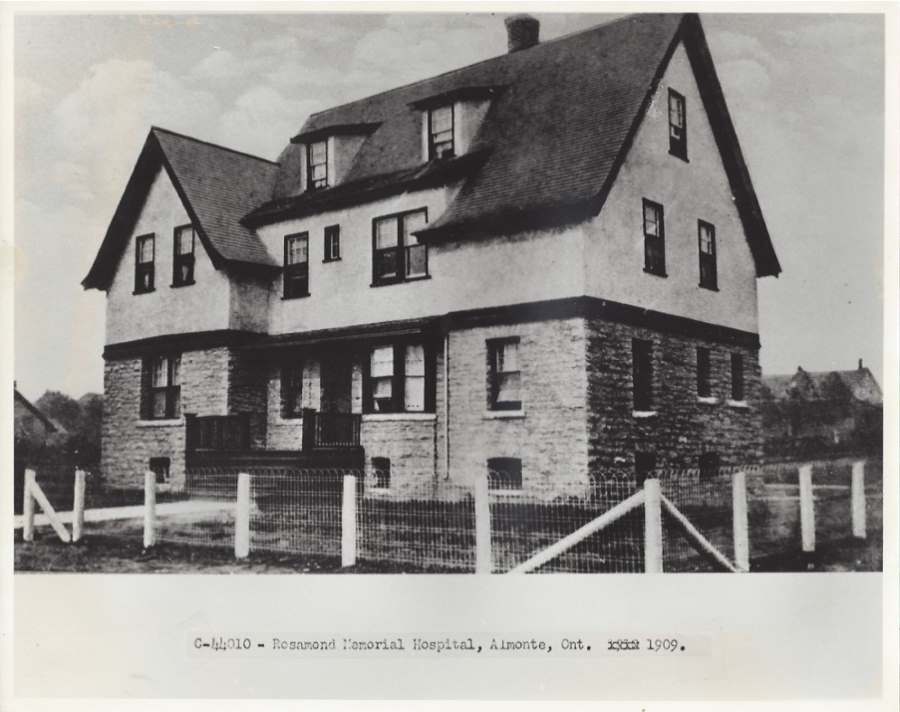
Bennett Rosamond funded and built the Rosamond Memorial Hospital in Almonte. He erected the fine stone building at the corner of Clinton and Spring Streets at his own expense, with construction starting around 1906 and the facility officially opening in May 1909.
Information:
Lanark Archives; Henry Langley, dictionary of Canadian biography online; Angela Carr, Toronto Architect Edmund Burke: Redefining Canadian Architecture.
