


On this Remembrance Day, like every other one, we remember those who have served. We remember those who have died. Those who have returned scarred both mentally and physically. We remember those who answered the call of duty.
We remember all of those who have experienced the devastation of war.
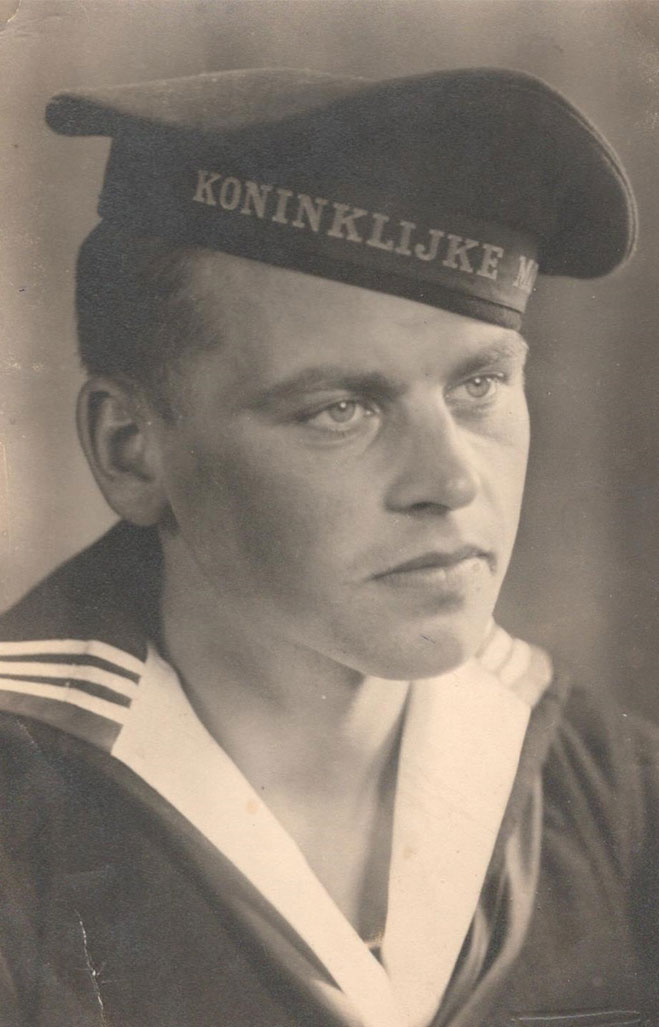
My father, Nicolaas van Duyvendyk, joined the Dutch navy in 1939 shortly before WW2. His father died when he was ten and he was encouraged to leave home and get a job. He was 16 years old. After the German invasion, the Dutch surrendered to the Germans within a week in 1940. My father was a prisoner of war but soon escaped while he and those on his ship were being transported by foot along a dike. He was being brought to Hamburg in Germany. He slipped out of line in the night and hid in a boat that brought him back to his hometown of Krimpen. His mother told him that he couldn’t stay at home and sent him to a relative that had a farm. He spent over four years hiding on farms around Holland. During this time he studied English and German and accounting, not knowing how the war would turn out.
The Germans often checked out farms. One farm had a hideout under a pigpen which was covered in manure. Nico had to stay underground sometimes for weeks at a time. The Dutch had stacks of loose hay that was stored under a roof that could be elevated on long posts depending on how much hay was stored at the time. Several times long poles were thrust through the hay looking for boys. Nico had the poles glance his back and pass under his arms but he was never discovered.
Once, while talking about the war around the supper table with my parents and siblings, my mother told a story about how a bomb landed behind her house in Lekkerkerk. Two of her little brothers were hit with shrapnel in the backyard. One had shrapnel in the head and never mentally recovered. The back of their house was blown open and repaired with makeshift boards which let in the cold.
While hearing the story about my mother’s brothers, I said that I hated the Germans! It was then that my father said, “Do you hate the German soldier that saved my life?” He went on to tell a story about how, while in the underground, he would be moving rifles packed in a manure spreader from town to town. He was stopped, asked for identity papers, and brought to a local German headquarters. While the Germans were examining his fake papers in another room, a young German soldier about my dad’s age came out of the office. He told my dad that they knew his papers were forgeries and unlocked the door so Dad could escape. He ran like hell and got away.
I realized later that so many of the soldiers on both sides were just teenagers. Sometimes I think about that when I see some teenagers walking down the street. I appreciate that my father didn’t want the hatred to spread to a new generation.
It didn’t.
For the V-Day plus 20 years celebration in May of 1965 in Calgary, my father took us all to the Jubilee Auditorium on the North Hill. There was a wide-open space where all the vets from WW1, WW2, and Korea would march by. I saw my scout leader and one of my friend’s dad marching by later that day. They were both in their late 30’s or early 40’s in age.
Before we left on the morning of the event, I had to polish my Sunday shoes, put on a white shirt and wear my elastic band tie. My father gave me a lesson in polishing shoes. First, you lay down a piece of newspaper. I spread the black polish with a small round brush sparingly after brushing off and dirt first. Then I used a bigger brush, the black one, not the brown one, to buff up the polish until it shined. Finally, I buffed the shoes with a piece of cloth cut from an old diaper. “Shoes are really important in the military”, he explained, “you have to polish your shoes every day and they have to be so shiny that you can see your face when you look down at them”. If your shoes aren’t perfect, you have to leave the line and do them again. I wondered why you needed to have polished shoes to fight in a war but kept those thoughts to myself. From that day forward, I would polish my shoes on Saturday night so they would be shining on Sunday for church.
I asked him why I had to go to the VE Day services while all my friends had the Saturday off to play. He thought for a moment. “I want you to look into the faces of the men as they march past. These are the faces of the people that liberated Holland. Many of their friends didn’t come back to Canada. This is a special day to remember and thank them.”
I think of my Dad often while polishing my shoes. I can’t quite see my face when I look down at them, but I see his face smiling the way only a father knows how to smile. I always remember Remembrance Day.
These days the day has a much broader meaning than it did back then. Millions of people were displaced by wars and moved to Canada. Thousands of Canadians are scarred both physically and mentally by war, both civilians and soldiers. Millions of people lost sons and daughters, husbands and wives, or other loved ones. Power and wealth continue to taint leaders around the world who see war as a means to consolidate their hold on government.
I’m thinking of ways to make the day meaningful for my grandchildren. Lighting a candle comes to mind. Connecting with the Syrians that our church sponsored and brought to Almonte to be safe from war is another. While teaching, my students would write letters to Canadian soldiers serving in Afghanistan. Sometimes all we can do is remember them.
I remember this day because of the incredible example our father gave us. Long may we all live in peace. Thank all of you who, living and dead, that have served your country by putting your own lives at risk. You are remembered.
