

I’ve written here before about my interest in the spread of AI technologies, from their halting early steps when they seemed like little more than mildly amusing party tricks, to today when their potential impact on work, culture and education prompts increasing anxiety about where they’re taking us. But as I’ve said, they’re here and they’re not going away.
So what are some of the upsides of AI?
I spent most of my career (and now retirement) at the intersection between technology and traditional communications skills, wondering, “How could each new digital thing that comes along help me tell stories and explain things better to people?” That convergence started with desktop publishing in the 1980s; then came the World Wide Web in the early 1990s. It, together with social media, YouTube and other digital channels, has profoundly changed how most people receive and process information about their world.
And now AI. I use it regularly for a lot of things—generating stock images, researching complex topics, and especially writing computer code. Current AI offerings are getting very good at this and can spit out working code in a few seconds that might have taken an experienced developer days to complete. It likely won’t be perfect and will still need human experts to detect logical or security flaws it may very well contain, but as a foundation it will usually be quite adequate.
This also means that people who—like me—aren’t expert coders can create useful apps they couldn’t have otherwise. While I know the rudiments of some of the main programming languages, with AI I can now make things that wouldn’t have been possible for me even a year ago.
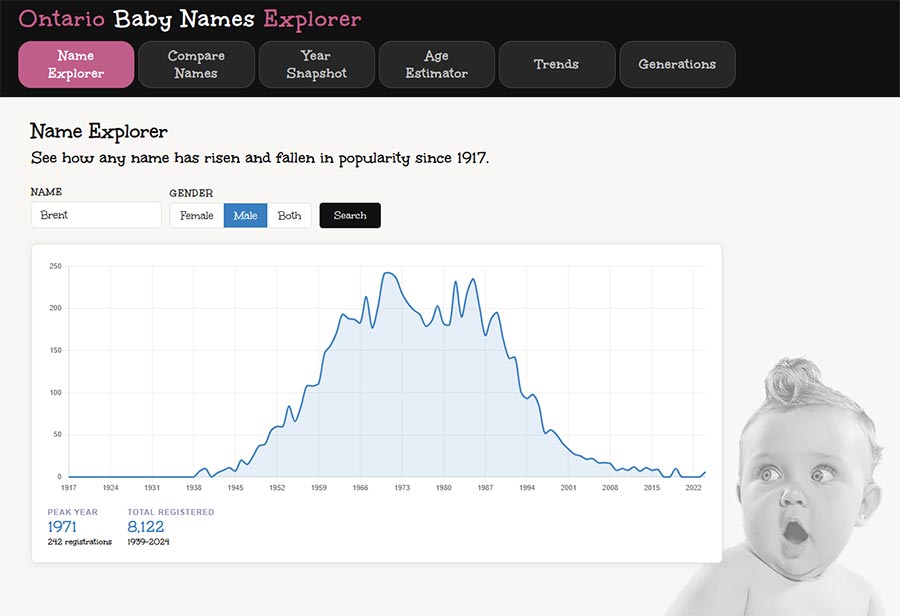
Which brings me to the Ontario Baby Names Explorer. It started with my trawling through the Ontario government’s open data website, which contains a lot of interesting stuff—including spreadsheets of baby names registered in the province between 1917 and 2024. I asked Claude AI for suggestions on entertaining ways of displaying this data, and after a few iterations and some design tweaks, I had a finished, working application. Here’s what it does:
Name Explorer: See how any name has risen and fallen in popularity since 1917.
Compare Names: Plot multiple names on one chart to see how they peaked and traded places.
Year Snapshot: The most popular names registered in any given year.
Age Estimator: What age is someone with a particular name likely to be today?
Trends: Names surging or fading from 2014 to 2024.
Generational Names: The names that defined each era — ranked by how popular they were in that period.
Give it a look: https://millcomm.ca/babynames/
