

Part 4 in a series about Light Pollution, by Rick Scholes
See also Part 1, Part 2, and Part 3
Here’s a bold statement: more light at night is not safer! Security companies, lighting suppliers, and even the police all urge us to light up our properties and roads for better safety. But what if “light equals safety” is a myth, a platitude, a misconception? What if it has been repeated so often it’s no longer questioned? And what if it’s not true?
The need for light at night is an emotional issue. Let’s take a moment to think about it dispassionately. Many people, particularly city dwellers, feel safer in lit areas. However, light itself does not immunize us against crime or accidents. The amount and type of light can compromise our safety in two ways: by impairing our night vision, and, by creating blind spots where we cannot see hazards.
In Part 2 of this series, I explained how and why glare impairs night vision and can cause momentary blindness. Glare can result from excessive light intensity, improperly directed light, blue spectral content, or a combination of all three. Indiscriminate lighting does not take into account these factors.
How glare reduces safety
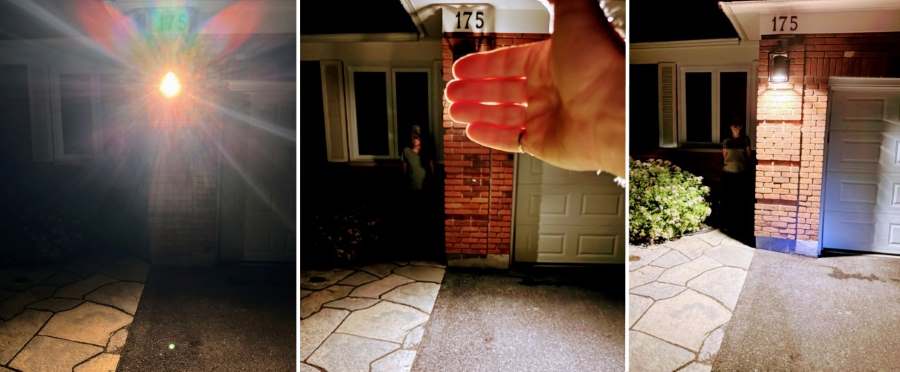
Consider a light on the front of a residence. The intent of the light should be to illuminate the walkway, signs, doors, and keyholes, not your eyeballs. Any light that shines directly in your eyes will impair your night vision to some extent. (This is one of the definitions of light pollution.) It’s worse if the light is an LED, due to its blue content.
Paul Bogard’s excellent book “The End of Night” (2011) included an image which vividly demonstrated this problem. I have re-created his demonstration with my own images below. A glaring light obscures much of the surroundings. Blocking the glare reveals the lurking “bad guy” in the shadows. A well-shielded light fixture illuminates the walkway perfectly well but eliminates the glare so your eyes can see into the shadows.
R. Scholes (CC-BY-NC 4.0)
This same fault can be found at many house or apartment entranceways and garages, and also along pathways lined with trees or fences. The solution is not to light up the entire outdoors. The solution is to light only what needs to be lit, just enough but not more. Lighting up the entire yard may feel safer, but is it? There will always be a shadow somewhere, and that’s where the intruder will hide. If the intruder is looking to break in, light will make it easier for them to survey and navigate your property. Less light may force them to attract attention by using a flashlight.
Alternative security measures such as motion-activated lights and security cameras are very effective deterrents that also pollute much less or not at all. Inexpensive security cameras that operate via Wi-Fi can send alerts to your mobile phone if motion is detected, even distinguishing between humans and animals and allowing you to broadcast your voice from them. “Hey dude, step away from my car.”
By the same token, lighting up the inside of your house and not closing curtains or blinds shows everyone what you’ve got and adds to light pollution at the same time. Closing curtains and blinds at night solves both problems.
What the Data Shows
The Chicago Alley Project is a famous study done by the Illinois Criminal Justice Information Authority in the year 2000. Two areas of the city with the same demographics and size were defined. One area was “upgraded” by adding more alley lights and increasing their wattage from 90W to 250W. Crime statistics were compiled for both for a full year. No significant difference was found. (There was actually slightly more crime in the “upgraded” area.) The final report states, “…it is difficult to point to any conclusive evidence that increased alley lighting had an effect on crime.”
A study published in 2015 examined 62 districts in England and Wales over a 13 year period and also found no evidence that reduced, dimmed, or switched off streetlights had any impact on traffic collisions or crime (BMJ, Journal of Epidemiology and Community Health, Vol.69, Issue 11). These and other studies can be found via the DarkSky website. As the site points out, “Outdoor lighting at night doesn’t do what you think it does.” In other words, you may feel safer, but you are not actually safer.
Marker lights
A “marker light” is a light where the bulb is more visible than what it’s meant to illuminate. It makes sense for hazard lights and traffic lights to be markers, but not property lights. A shielded fixture that points most of the light down will illuminate both your visitor and the step they need to negotiate. Lighting for a sign should point down to illuminate the sign, not your eyeballs or the sky.
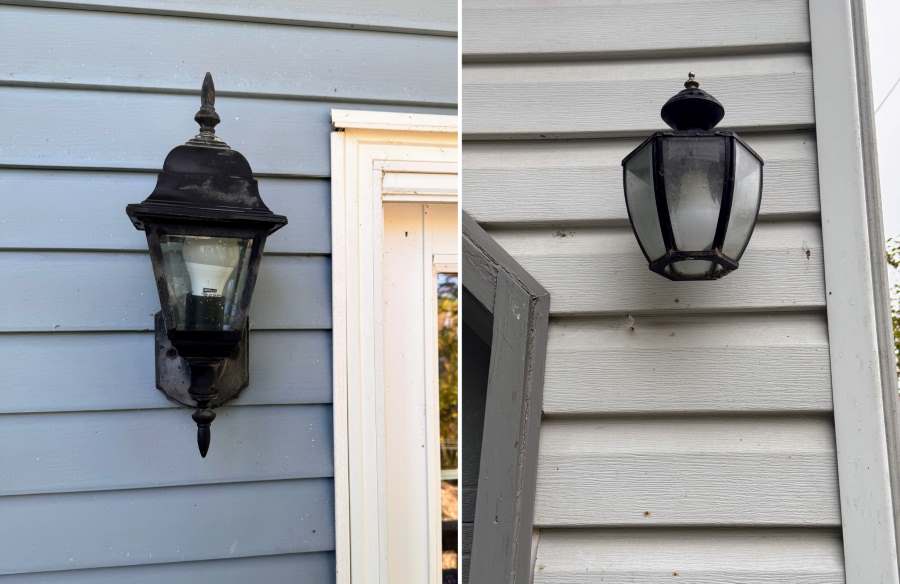
Coach light (or lantern style) fixtures, shown in the images below, are examples of marker lights. Most of the light shines sideways. This design dates from the gas lighting era in the 1800s, when the soft yellow light was too dim to ruin your night vision. Bright electric lightbulbs are a different story and our now-standard LED bulbs emit blue content that exacerbates glare. Fixtures like this are no longer appropriate. They simply don’t do a good job.
R. Scholes (CC-BY-NC 4.0)
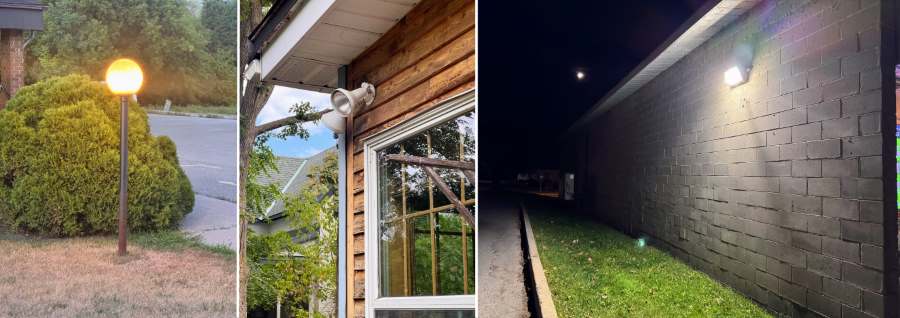
Next time you’re out at night, notice how much bad lighting there is. It’s everywhere. It’s not intentionally bad. It’s just been designed either with no thought or with the misguided idea that more must be better. Some examples are shown below. The globe light looks pretty but wastes more than half of its light by shining it up into the sky. Floodlights also waste light, much of it wasted into the sky and/or trespassing onto a neighbour’s property. “Wall packs” are simply lazy lighting design, sending glare light in all directions and, in the case shown, needlessly illuminating a totally blank wall.
R. Scholes (CC-BY-NC 4.0)
Entrenched ideas about appropriate lighting and light fixtures no longer serve us well. And speaking of not keeping up with technology …
Blinded by the (Head)light
Automobile headlights are a common complaint these days. Is that oncoming vehicle properly in their lane, or straying over the centre line? You need to know. But you also need to know where the ditch is on your right side, and it’s darker over there. Even as you try to use your peripheral vision, that headlight has caused your iris to shrink and saturated your rod receptors. I’ve seen vehicle headlights that were so bright they swamped and made invisible their own turn signal, a pretty obvious safety hazard.
Over-illumination subverts how our eyes were intended to work, impairing night vision and causing momentary blindness. Immediately, and for the minutes that it takes your night vision to recover, your hazard perception is impaired. If you don’t look at the oncoming headlights, you might collide with them, and if you do, you risk hitting the pothole, the pedestrian, the deer. We now play a new version of the game of chicken on our roads.
At the very least it seems that North American automotive regulations have not kept pace with the latest headlight technology (LEDs). European safety standards (ECE 48) call for better glare control and beam patterns than the US Federal Motor Vehicle Safety Standard 108. European headlights have more horizontal cutoff, and a right-side “step-up” feature that illuminates signs and road sides without blinding other drivers.
I am encouraged by the sense that younger generations of lighting designers are better educated about light pollution and its range of negative effects. We will make progress as more people realize that more light is not better and, in many cases, makes us less safe. We need to strive for the right light, applied thoughtfully when needed, rather than indiscriminately spread at all hours.
Part 5 in this series, “The Night Sky: Abatement”, will explore the light pollution abatement activities we can pursue as individuals, citizens, organizations, and governments.
