


August was a good month at our cottage on White Lake for seeing birds we do not see every year. Many bird species are reliable cottage visitors. We can count on seeing common loons, eastern kingbirds, and many others every year, but the appearance of some constitutes a special treat. Even accounting for northern and southern migration, some birds that you might expect to see simply hide from us some years.
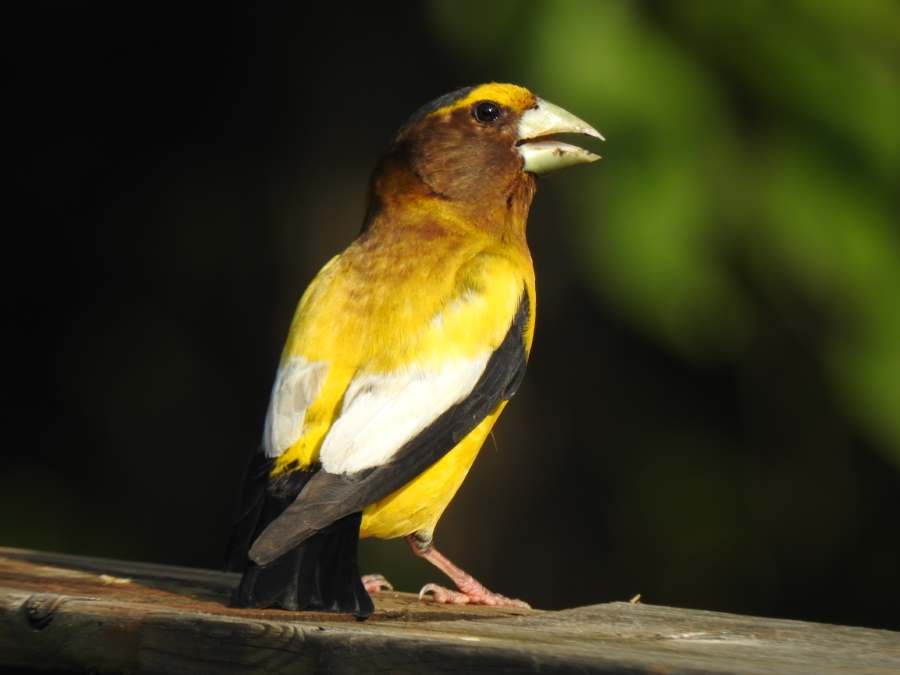
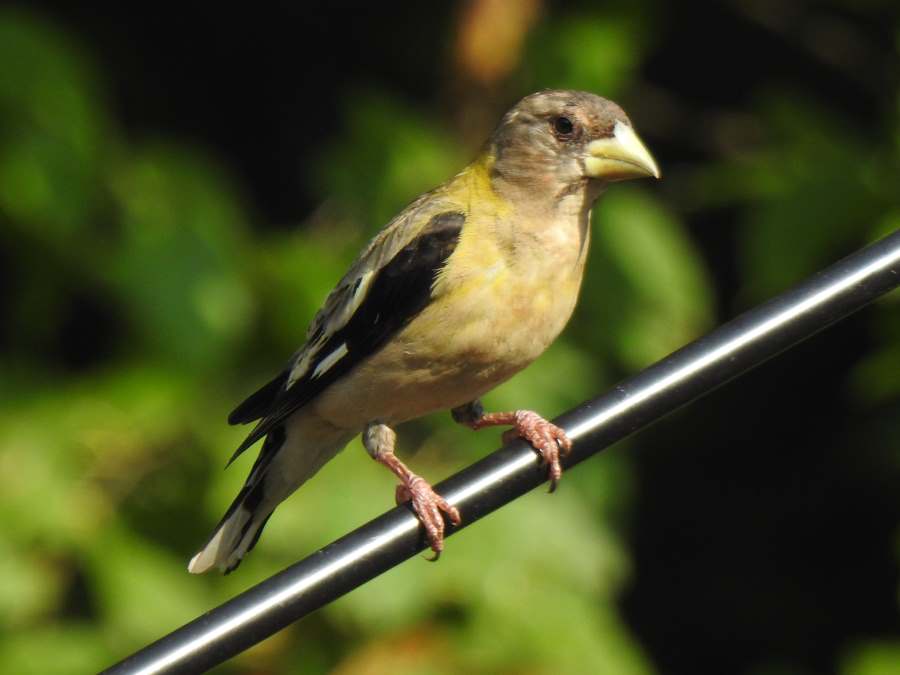
This year we were especially delighted to see evening grosbeaks, both male and female, at the sunflower seed feeder. A large bird at a maximum of 18 centimeters, our small seed feeder posed a serious challenge to the evening grosbeaks which visited between August 16th and 18th. We can only assume they were hungry because they persevered and dominated the feeder during their short three-day stay. Their smaller American goldfinch cousins did not have a chance against this bulky bully. A contender for ‘favourite’ status, the gold and black male evening grosbeak with its large yellow bill is unmistakable. The first photo below is a male; the second is a female.
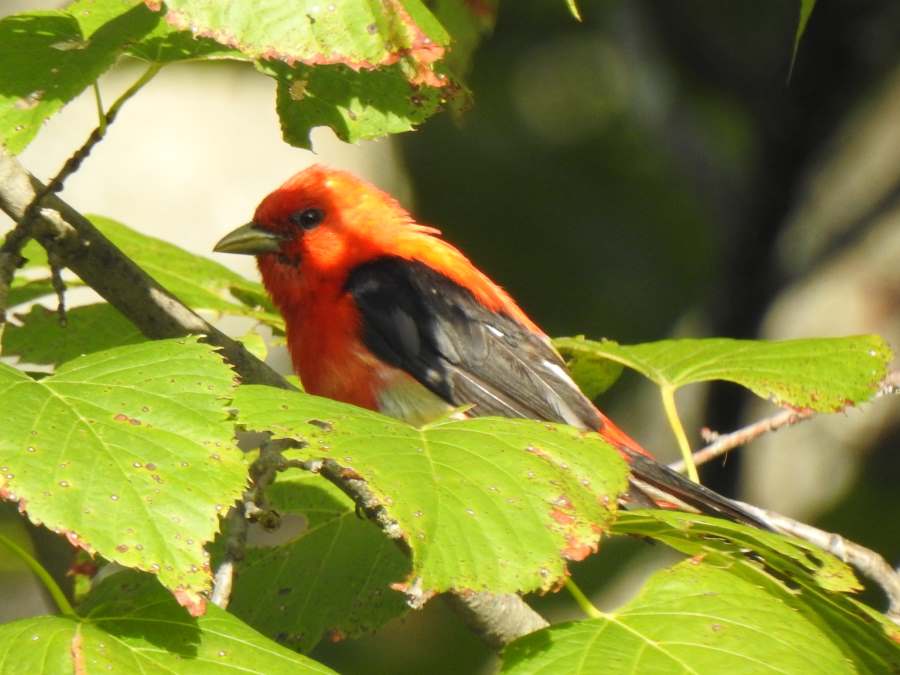
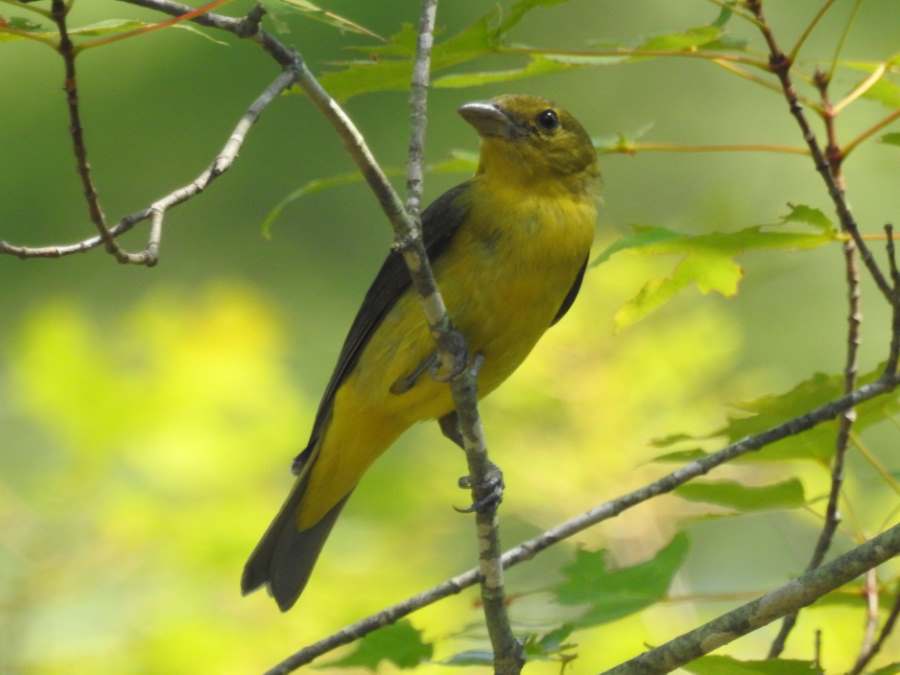
Another unmistakable visitor we see less frequently than we would like is the scarlet tanager. In the past, we have seen scarlet tanagers in May, June, or July, but in 2025 this male appeared in mid-August. We might see the females here more often but it has taken us some time to learn to identify them as they are much drabber than the males. Usually, we have to rely on experts to confirm her identification. The female scarlet tanager is nevertheless a beautiful bird, greenish above and pale yellow on her underside. Another reason we may not see either gender often is their preference for tree canopies. As the friendly giant said, “Look up. Way up.” The first photo below is a male; the second is a female.
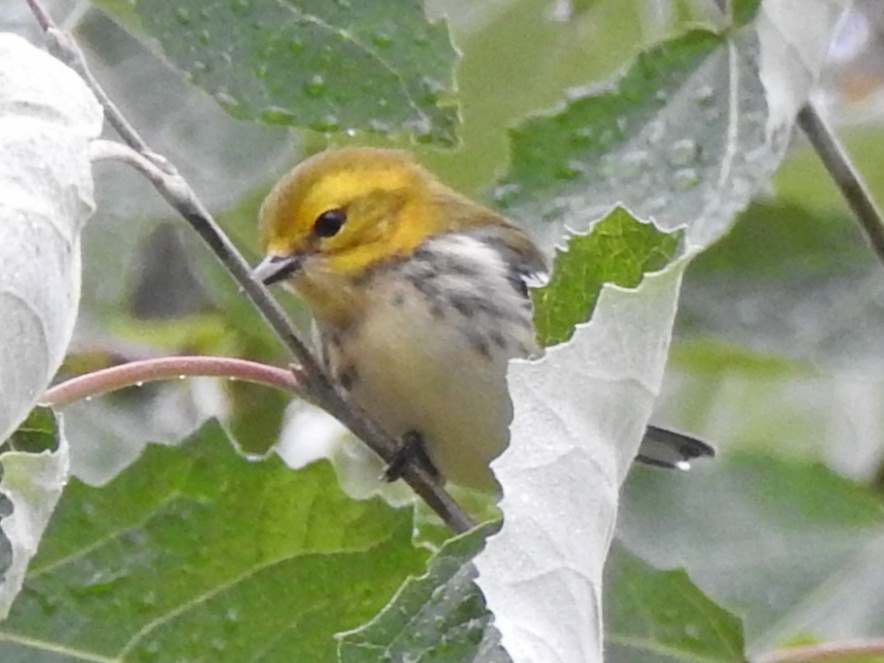
We were delighted when our intrepid photographer captured a photo of a black-throated green warbler deep in the forest one day early in September. We have seen this bird six times over the past 18 years, and it is always a thrill. Our reference books tell us this warbler is relatively easy to identify, but it has not been so easy for us. The black-throated green warbler is another species we always request expert help to confirm the identification. Once this photo was cropped, we could see the yellow eyebrow and cheeks, olive-green crown, and faint black streaks on the side of its breast. We would be happy if we could see them during the spring when they sport their brighter breeding colours.
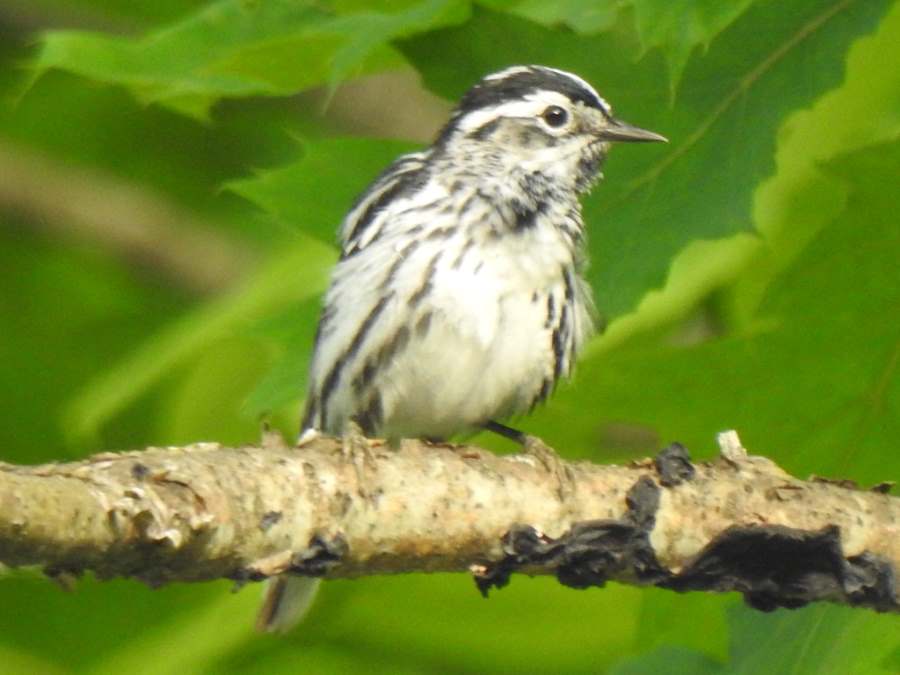
We have seen the black and white warbler from time to time since our first sighting in 2016. It seems that once we see a species, we are more likely to recognize it in future years. Black and white warblers are found primarily in deciduous forests. Our cottage being situated in a mixed forest of pine and deciduous trees may explain why we do not see these birds as often as we would like. Also, their striped plumage provides effective camouflage. Black and white warblers have long bills which they use to probe for insects in tree trunk bark crevices. They nest on the ground against tree stumps.
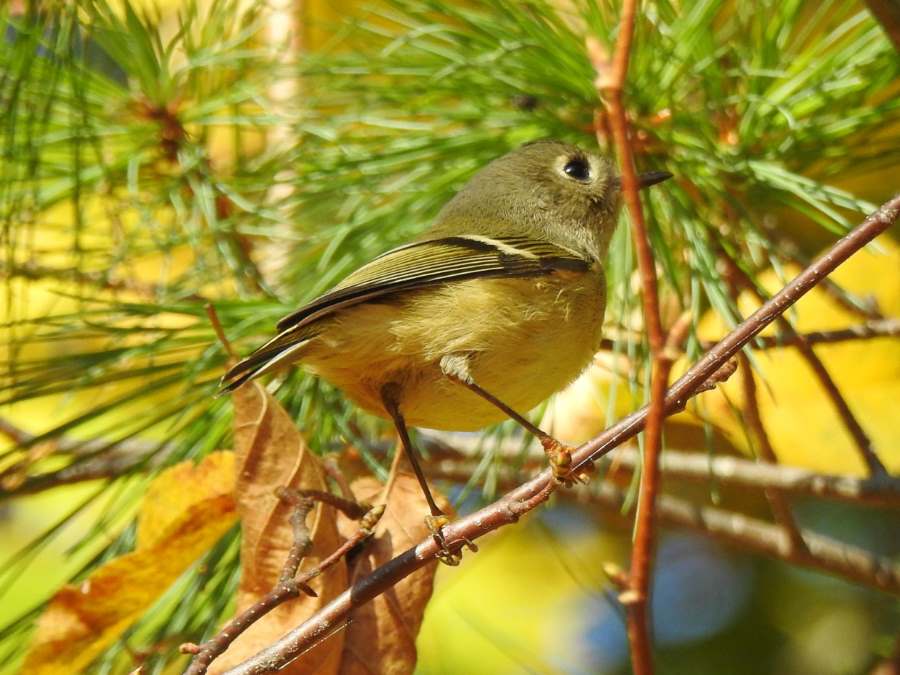
We were overjoyed to see a female ruby-crowned kinglet just a few weeks ago in a bush at the edge of our cottage yard. Our reference books tell us this kinglet is common and easy to identify. Perhaps the authors of these books are younger than we because the previous and only ruby-crowned kinglet we have seen was in 2016. This small bird grows to 10 centimeters and seldom sits still. The male’s famous red crest on its crown is seldom useful for identification because it is raised only when the bird is agitated. If ruby-crowned kinglets are in our bushes, their white eye rings and wing bars might be helpful in identifying them. We would love to see these tiny birds more often.
As you know, our favourite birds are usually the species we see most often, and have learned to identify, as well as those that eat biting, blood-sucking insects (black flies and mosquitoes). Many beautiful birds are contenders for our designation of ‘favourite’. The evening grosbeak is already on our list of favourites although it is a seed eater. The scarlet tanager is nearing favourite status. We are working to become more comfortable with the identification of the black-throated green warbler and we are looking forward to seeing black and white warblers more often each year. We truly hope to see the ruby-crowned kinglet more often too. We enjoy the ongoing challenge of listening, watching, identifying, and learning. We look forward to these challenges.
For this article, we depended primarily on David Bird’s Birds of Eastern Canada, but consulted with the friendly experts on Facebook’s Ontario Birds and on iNaturalist.ca about identifications.
