

Part 5 in a series about Light Pollution, by Rick Scholes
See also Part 1, Part 2, Part 3, and Part 4
Why do gas stations need to be lit up like hospital operating rooms? They don’t. You can find a gas station and your filler cap with far less light. And when you drive away, your night vision won’t be as impaired. Changes are always possible if a society decides they’re necessary. Collectively we need to be less tolerant of unnecessary light at night.
Light pollution has been called a “global disruptor”. The preceding articles in this series have explained the various ways this causes damage. Whatever your concern – the climate, sleep, waste of power, being a good neighbour, birds, fireflies, nocturnal creatures, glare, road safety, or the night sky vista – there is a good reason to support reducing light pollution.
The majority of light pollution results from lack of awareness and misconceptions, and not malicious behaviour. We can all help to reclaim the night using relatively simple light pollution abatement (LPA) techniques. If you’re convinced that LPA is a worthy cause, you can skip to the summary section at the end for a handy list of tips. If you want all the details, then read on.
Timing and Shielding
Light can be comforting. Light makes us feel civilized and safe. A certain amount of light is necessary. I’m not here to tell you to turn off all your lights.
Tip #1: Switching off lights that aren’t needed, however, is a good start and saves money. If you drive around the older parts of a town – Almonte for example – you’ll see many houses that leave their outside lights off at night. Are these residents more energy conscious? Do they appreciate dark skies more? On the other hand, in newer subdivisions that resemble suburbia there are more residences with outdoor lights on. Not all, but more. Is this because many newcomers have come from more populated places where they’ve been desensitized to light pollution? Few of us have visitors after bedtime. The need for outdoor residence and business lights at 2 am is unclear.
Tip #2: Inexpensive wall switch timers for outdoor lights can be programmed to turn on at sunset and off at, say, 9 pm, or whatever time after which no visitors are expected.
Tip #3: Shielded light fixtures are always best to reduce glare and improve night vision. In Part 4 of this series I noted that the common lantern-style fixtures are poorly shielded. A properly shielded fixture directs most of the light downward, a little sideways, and none upward. Two examples of such fixtures are shown in the photos below. They shine light where it’s needed, on the doors and the threshold. The bulb isn’t visible unless you’re right under it, so they cause no glare.
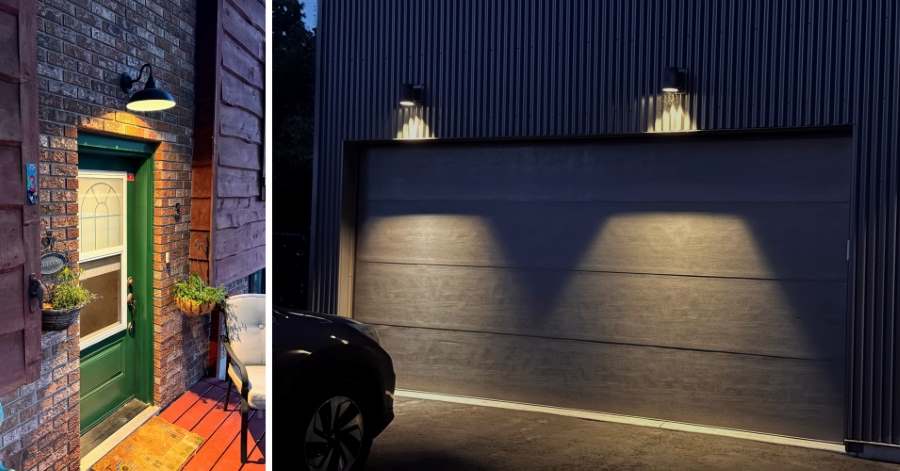
Photos: R. Scholes (CC-BY-NC 4.0)
Totally unshielded fixtures include floodlights (often over garages or decks), globes, and bare bulbs. The light pollution they contribute depends on the bulb intensity, colour temperature, and how often they’re turned on. Consider shielding them, choosing lower intensity bulbs, and/or directing them down as much as possible to reduce the glare and light trespass.
Tip #4: Motion detectors are an effective solution that only activate lights when necessary, to welcome a visitor or startle an intruder.
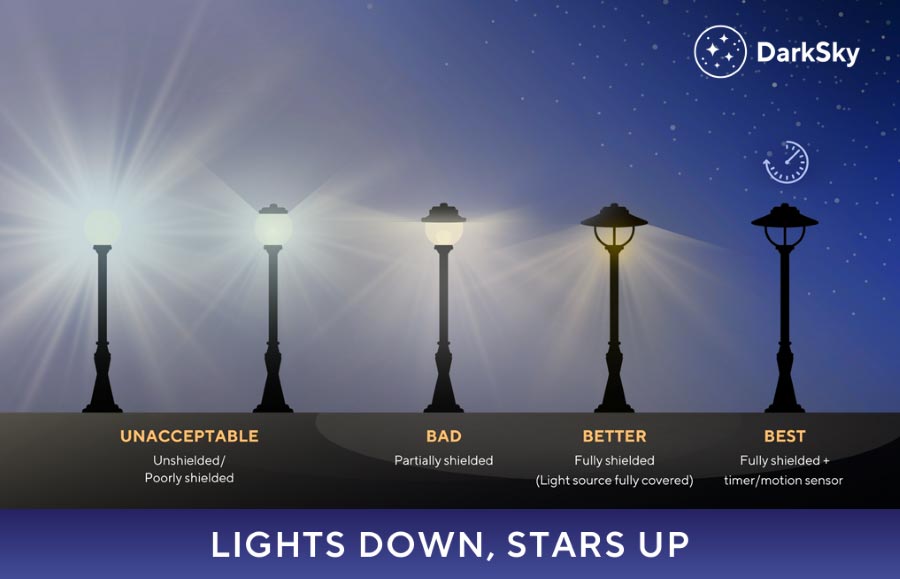
Image credit: Darksky.org
Pot lights in roof eaves, and lights under porches are shielded in the sense that they do not shine upward, but they still may cause both glare (if the bulb is visible) and skyglow (from scattering off the ground, cars, etc.). Those problems can be mitigated by using timers, leaving them off unless needed, and/or choosing lower colour temperature lights (see the next section).
Intensity and Colour Temperature
Shopping for lights is a challenge. LED lights have changed all the rules: intensity is in lumens, with “equivalent wattage” values quoted, and a variety of colour temperatures instead of just “warm” and “cool”. (Choices also include dimmable vs. non-dimmable and a smorgasbord of “smart lights”, adding more layers of complication.)
Tip #5: Choose the minimum intensity level needed to illuminate the walkway, steps, or door. Usually 800 lumens (equivalent to 60W incandescent) will be enough. Lighting up the entire outdoors is impractical, wasteful, and counterproductive.
Tip #6: When choosing colour temperature, the most commonly available models with the least amount of harmful blue content are currently those at 2700K. Other choices are those at 3000K (a little whiter) and around 2000K (more amber). Different colour temperature 800 lumen light bulbs are shown in the photo below. The 5000K light is clearly bluer and more glaring.
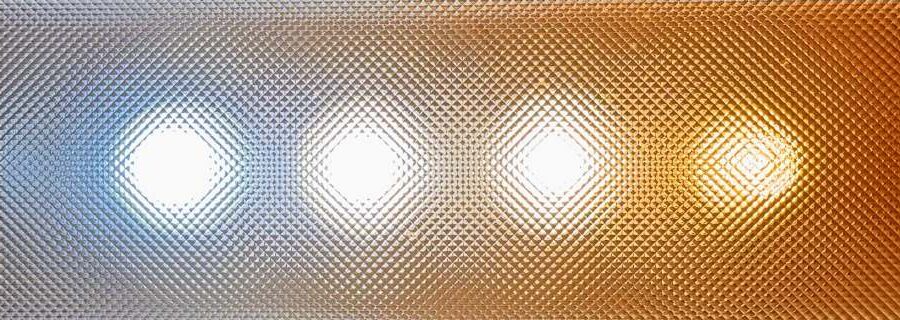
Photo: R. Scholes (CC-BY-NC 4.0)
Restrict 4000K and 5000K lights to indoor areas where attention to detail is needed: kitchens, bathrooms, and workshops. It is best to use lower colour temperatures even in fully shielded fixtures, lights in covered porches, and pot lights, because they cause less glare and blue light scatter (see Part 2 of this series).
Decorative Lights
Recently there has been an explosion in the use of decorative lighting. The practice of leaving Christmas lights on well after the end of the festive season began during the COVID pandemic. It now seems to be trendy to leave decorative lights on all year, morphing the special into the routine. Cheap LED lights have also enabled the latest craze, “soffit lighting”. A sizable portion of this light will reflect back up into the sky and may trespass into your neighbour’s windows. Even though soffit lights are predominantly facing down under eaves, their light bloom is plainly visible from above, sometimes even outshining streetlights. (As reported to me by a pilot.)
Tip #7: These systems are programmable, so making them amber or red will reduce the harm, as will having them switch off in the late evening. Strings of lights in the backyard interfere with nocturnal creatures. Decorative lights don’t make sense when there’s no one looking.
Municipal Lighting and Bylaws
Street light fixtures are under municipal control. LED luminaires are now offered at 2700K for the same cost as the current 3000K lights. I recommended this change to Mississippi Mills town council and staff, for any new installations or failure replacements, since they have less of the blue light content that causes glare and light pollution.
Tip #8: Consider writing your town councillor if you support this or any other light pollution reduction initiatives.
While Mississippi Mills has done well, it is possible to do better. Flagstaff, Arizona (city population 77,500, and 145,000 in the metro area including the Lowell Observatory) was recognized as the world’s first International Dark Sky City in 2001 thanks to their widespread implementation of night sky-friendly lighting. This took an effort across the board: residential, commercial, and civic infrastructure including road and public space lighting. Flagstaff is bathed in a warm amber glow at night, because they transitioned to LED lights by choosing lower colour temperatures. There is a new LED product called Narrow Band Amber (NBA) which contains no blue at all. Why not use them everywhere instead of just ecologically sensitive areas?
Bylaws are a tool to limit light pollution. They force us to ask questions like “why pay to light up your neighbour’s property?” and “how is it right that a street light or a neighbour’s floodlight glares into your bedroom?” Mississippi Mills enacted an Outdoor Illumination Bylaw (bylaw 03-62) in 2003, thanks to forward-thinking people within the community and the municipal government. It specifies the illumination levels for roads and streets, limits illumination levels on building and advertising signs, and discourages light trespass.
I prefer to think of a bylaw as a way of raising awareness rather than a method of punishment. Our bylaw is something to be proud of and has been used as a model by other communities concerned about light pollution. Municipalities in Ontario with a dark sky bylaw include: North Frontenac, Manitoulin Island, Huntsville, and several townships in both the Muskoka and the Georgian Bay peninsula area. The city of Guelph has one in development. Other communities prohibit light trespass in their property standards. Over a dozen municipalities along the Ontario lakeshore from Kingston through to Mississauga and Burlington prohibit “nuisance lighting.” North Frontenac Township in Eastern Ontario was the first municipality in Canada to be designated as a Dark Sky Preserve in 2013. It is noteworthy that places still enjoying dark night skies want to preserve them.
Among countries, France has taken significant light pollution abatement steps. Since 2013 their laws require that store lights must be dimmed after 1am and business lights after the last person leaves. It has been estimated that these measures save the energy consumed by 750,000 homes, equivalent to about 250,000 fewer tons of CO2 dumped into our atmosphere. And that’s just one country.
Summary
More is manifestly not better where artificial light at night (ALAN) is concerned. Light pollution is a fixable problem, one light bulb at a time. Here’s my list of steps you can take:
- Switch off lights that aren’t needed, both outdoor and indoor (or close curtains)
- Use timers to automate on/off cycles (on at sunset, off later on)
- Use shielded light fixtures (bulbs not visible); minimize the use of unshielded lights
- Use motion detectors to control lights
- Choose the minimum intensity level necessary (typically 800 lumens)
- Choose lower colour temperatures such as 2700K or less
- Program decorative lights to use warmer colours and switch off at bedtime
- Write your elected representatives in support of light pollution abatement
I’ve appreciated the wonders of the starry night sky since my teenage years in suburban Montreal. Then, as now, you had to leave the big city to experience truly dark skies that create a sense of awe. Dark skies allow humans, birds, plants, and trees to get a proper night’s rest, while nocturnal creatures go about their business. Now, we realize that light pollution is an ecological and safety problem too. We’ll be healthier, wealthier, and safer with darker night skies … and less unnecessary light.
Lighting technology and implementation continues to evolve. Stay tuned for future updates on changes and progress in the realm of light pollution and abatement efforts.
