

by Arnie Francis
Ladies and Gentlemen…here’s Donnie!
You’ve seen him around Almonte. You “know” him.
You’ve spotted the Tilley hat, sunglasses and walking poles.
You’ve noticed him smiling at you when you passed him by.
You’ve watched him entering a local coffee shop with focused intent.
His name is Don McLeod. Now you are going to know him even better!
Next time, say “Hi Donnie!” He’d love you for it!
When Don McLeod first meets you, he smiles broadly and says “I’m Don…I have Huntington’s!”
That sincere and open expression of greeting really tells you almost everything you need to know about this very visible, 74-year-old Almonte personality.
Don was formally diagnosed with Huntington’s Disease (HD) [1] in 2003 but has lived with the symptoms of HD his whole life. Not surprisingly HD has largely shaped Don’s character, passions and pursuits over the years.
HD, in lay terms, (with thanks to the Mayo Clinic) causes nerve cells in the brain to decay over time, impairing a person’s movements, thinking ability and mental health. Children of a parent with HD have a 50 percent chance of having the gene-change that causes HD. HD is rare: a total of 33 studies published between 2010 and 2022 showed pooled incidence of 4.88 per 100,000, with significantly higher incidence of HD in Europe and North America than in Asia…. The time from the first symptoms to death is often about 10 to 30 years…. The depression linked with Huntington’s disease may increase the risk of suicide. Some research suggests that risk of suicide is greater before a diagnosis and then when a person loses independence.
Don was born on October 10, 1951, the third of 8 siblings. His mother had Huntington’s Disease. He and five other siblings carried the gene for HD. Two did not. Of the six siblings with HD, three have now died.
Considering Don’s family history and personal tragedies (Linda, his younger sister with HD, died in 2025) it is not surprising, then, that Don is very outspoken about the systemic, socio-political failures that serve to burden already over-burdened HD families. Over the last decade, Millstone News readers will have read his passionate letters to the editor beseeching employers and politicians to encourage enriching environments for Canadians with HD, to work to eliminate genetic discrimination[2].
He may have a point! The Mayo Clinic article further suggests that damage to the brain and brain function caused by HD have wide-ranging effects on cognitive conditions (like trouble organizing, prioritizing or focusing) and mental health impacts (such as depression or bi-polar disorders).
Huntington’s was not well understood or diagnosed before the 1980s. As a result, there was little attention paid to academic enrichment, so vital for people with HD; in consequence Don’s cognitive complexities elicited poor comprehension and retention, resulting in a mediocre school performance. This situation followed him from Nepean High School to Algonquin College in his studies in Electronics.
Don points out that his early childhood development years were impaired by prevalent attitudes of penalization rather than empathy and enrichment. His Grade 1 teacher, for example, pulled his hair abruptly in punishment when Don tried and failed to tie his shoe laces. Coordination was an issue even back then. It would be interesting, Don wonders to research what current attitudes exist in the schooling of HD children.
Catch-and-Release: Fishing as a Metaphor for Life
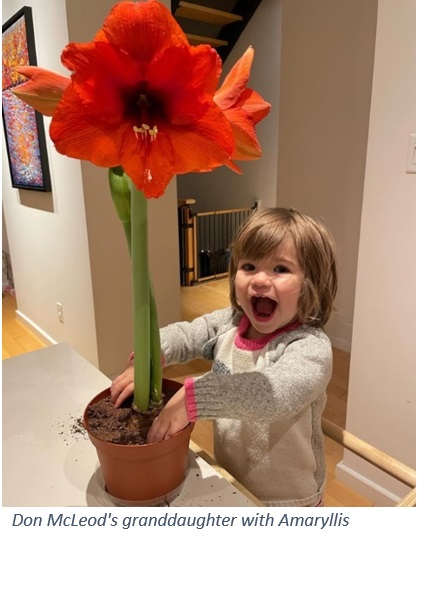
One of Don’s passions is catch-and-release fly-fishing. He claims that his secret fishing hole on the Tay River, in a near-shore, shallow, warm water location, is THE spot to cast a 30-foot line to catch 19-inch small mouth bass! And he is happy to teach novices. It is no “fish story” that Don’s other passion is his four-year-old granddaughter. Naturally, he is teaching her how to fly-fish. His daughter, Nyssa, a Special Advisor at Finance Canada, is close at hand in the Ottawa area, and helps the family with the annual Huntington’s Society’s Amaryllis Fundraiser. Don’s son Kevin, on the other hand, lives in distant Thailand. For Kevin, sadly, HD has marked its presence.
As young adults, Don recalls with a smile that his relationship with his wife-to-be, Jane, started off at Sears in Carlingwood Mall: “She was in candy, I was selling shoes!” They married in August 1976. Two children and a grandchild later, Don and his wife Jane each cope with their respective health challenges in the most constructive ways possible. Don struggles to never be in “uptight mode”, as he calls it, ever-cognizant of his emotional triggers. Most significantly, to make their relationship work, Jane lives independently in a condominium in Almonte and Don lives at Orchard View Retirement Village, where his care and nutrition regime are looked after. Jane and Don video-chat daily and meet for dinner at Postino’s each Saturday. Recently they celebrated their 49th anniversary at their favourite restaurant!
Catch-and-release is, perhaps, a metaphorical way to frame life’s challenges for a Huntington’s sufferer.
Falling Over Vertically!
Isolation is not good. Social withdrawal is a symptom of Huntington’s. Knowing this acutely, Don aims to regularly connect with people he knows and maybe even people he doesn’t know! In a letter to the Millstone Editor in 2014, Don references the Baumol Effect to help critique the municipality’s economic goals of building homes for cars rather than for people, thereby making walkability, so essential for human connection, a challenge. Don echoes a Jane Jacobs quote that “Most [sidewalk interaction] is ostensibly utterly trivial but the sum is not trivial at all.” Don argues that building walkable communities means “…More exercise. Healthier community. Less isolation. Less cost for health care.”

In this matter, Don practices what he preaches, actively attempting to “avoid the 5 Regrets in life”. Don participates with other retired Information Technology executives as they continue to meet socially. Three or four times each day, Don cuts up the streets of Almonte, regardless of the weather conditions. On a sunny, summer’s day you can often spot Don walking, poles in hand, Tilley Hat, dark glasses and water bottle, en route to and from his Orchard View home. The local coffee-shops and restaurants set a table aside for him for his breaks. When it’s too cold for you and I to be out, Don will still be slicing and dicing his way through the sleet, show and ice! But he admits ruefully that in dangerously extreme weather, he skips his outdoor trail-blazing!
The real challenge of walking for someone with Huntington’s, is “Huntington’s Chorea” – those involuntary movements that affect all the muscles in the body, primarily in the arms, legs, face and tongue. Chorea makes the simple act of walking on clear, level ground difficult and potentially dangerous. Posture and imbalance caused by involuntary
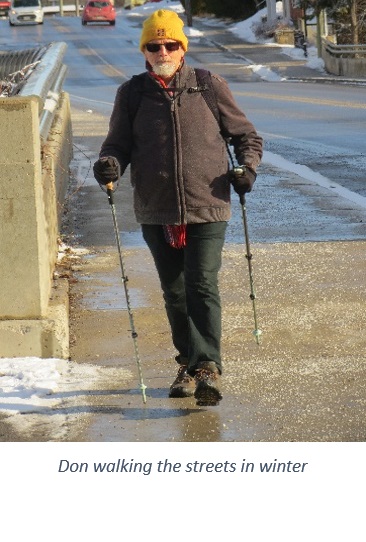
jerking or writhing movements may contribute to slips, trips and falls. Imagine the challenge of facing that possibility every day while walking on potted and uneven sidewalks and un-shovelled, snow-covered paths. Yet exercise is essential – keeping moving parts moving. Walking poles and a daily routine of carefully traversing Almonte’s less trafficked roads has been Don’s way of cheating death. A fact he gladly invokes in conversation.
The Collaborative Monkey
For Don, indeed, his most treasured achievement is in delaying the severity of his HD. He is rightly proud of recently hearing from his neurologist that there were no noticeable changes in his brain health. In one stanza of his poem “The Art of Getting Up in the Morning” Don writes[3]:
I need to get up in the morning.
God is not going to get me up.
A nagging spouse is not going to get me up.
Fear of consequences is not going to get me up.
It will keep me in bed.
I have to get my DNA to want to get up and face the day.
That means I have to convince my own DNA, that as a collaborative monkey, I am
contributing.
I must prove to it I have meaning and purpose.
It has to be real. That is our nature.
The Huntington Society of Canada’s website[4] states that “the universal goal for the international HD research focus is to find treatments that reverse, slow or prevent the progression of HD”. Today’s hard-science cannot answer all the questions. Don believes that our culture is built on the harsh ways of “Saxon” societies to rule, punish, guilt, ostracize, scream, assault and force people into protective enclaves of small cells, to stoke fear, to create isolation and to generate loneliness. The ultimate result is potential self-harm, carving out the self-fulfilling prophesy that the strong succeed and the weak implode.
According to Don’s readings these cultural attitudes run counter to the need for encouragement, enrichment, collaboration, touch, human connection and kindness, among other things. Research noted above regarding the higher incidence of HD in North America and Europe rather than Asia bears this observation out. Having lived and worked in Japan, Sweden, Holland, Malaysia and Hong Kong the contrast in socio-cultural conventions, Don notes, is huge. But Canada is home.
Don’s approach to managing his wellness – The Collaborative Monkeys Approach – is to compliment complete strangers, and then “wait for five positive interactions with 3 or 4 others before calling someone a friend”. This is not as easy as it sounds because HD can cause a slowness in processing thoughts, in ”finding” words or remembering to keep appointments. Strangers sometimes don’t have the patience to deal with the HD person’s idiosyncrasies. They want to finish sentences, jump to the punchline, “get-on-with-it”, rather than take the time to listen with intent. There is even intellectual judgement levelled at the unfortunate HD individual.
All to Say…
All to say that we have lessons to learn no matter our age and stage in life. Don McLeod reminds us that meeting and greeting people, smiling and acknowledging the other and reflecting on whether kindness or a middle-finger are due when someone takes ‘way too long to cross the street tell us more about ourselves than the object of our attention.
Next time you spot him on his walk, toot the horn gently, wave and say “Hi Donnie!” He’d love you for it!
[1] HD is an inherited (autosomal dominant) disorder in which there is progressive neurodegeneration, affecting the corpus striatum and cerebral cortex of the brain, and for which there is no known cure.
[2] The Genetic Non-Discrimination Act (GNDA) in Canada, enacted in 2017, prohibits forcing individuals to undergo genetic testing or disclose genetic test results as a condition for accessing goods, services, or contracts.
[3] Poem, The Art of Getting Up in the Morning, by Don McLeod. Contact the poem’s author to obtain a copy.
[4] https://www.huntingtonsociety.ca/
